Lipid quality associated with the fatty acid profile of fruit yogurts
DOI:
https://doi.org/10.58951/fstoday.2026.002Keywords:
Fermented dairy product, Atherogenic Index, Thrombogenic Index, Omega-9, Gas ChromatographyAbstract
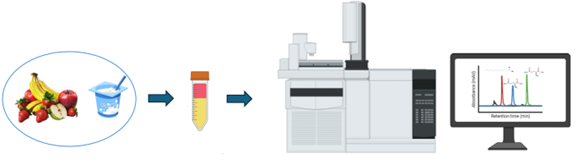
In recent years, consumers have sought foods with nutritional value and properties beneficial to human health. Among these, yogurts are considered a fermented dairy product known worldwide for their high nutritional value and the presence of probiotics. These products undergo various technological processes prior to commercialization. Thus, this study aimed to perform chromatographic analyses on six commercial samples of fruit-based yogurts, identifying the fatty acid profile and relating it to their lipid quality and applicable regulations. Fatty acids were extracted using the Soxhlet method, followed by a transesterification reaction and subsequent analysis by Gas Chromatography with Flame Ionization Detection (GC-FID). Lipid quality was evaluated through the atherogenic (AI) and thrombogenic (TI) indices. The results showed higher concentrations of saturated fatty acids, such as palmitic (C16:0) and myristic (C14:0). Lower values of AI and TI were found in strawberry yogurt sample (MG), associated with higher lipid quality based on the fatty acid profile. Therefore, this study may contribute to future research on the development of fruit-based dairy products with greater health benefits.
References
Akdeniz, V., & Akalın, A. S. (2025). Fatty acid profile and rheological and microbiological characteristics of yogurts produced by different cultures using power ultrasound compared to homogenization. International Dairy Journal, 169, 106329. https://doi.org/10.1016/j.idairyj.2025.106329
Ardabilchi Marand, M., Amjadi, S., Ardabilchi Marand, M., Roufegarinejad, L., & Jafari, S. M. (2020). Fortification of yogurt with flaxseed powder and evaluation of its fatty acid profile, physicochemical, antioxidant, and sensory properties. Powder Technology, 359, 76–84. https://doi.org/10.1016/j.powtec.2019.09.082
Aryana, K. J., & Olson, D. W. (2017). A 100-Year Review: Yogurt and other cultured dairy products. Journal of Dairy Science, 100(12), 9987–10013. https://doi.org/10.3168/jds.2017-12981
Chen, J., & Liu, H. (2020). Nutritional Indices for Assessing Fatty Acids: A Mini-Review. International Journal of Molecular Sciences, 21(16), 5695. https://doi.org/10.3390/ijms21165695
Fernandez, M. A., & Marette, A. (2017). Potential Health Benefits of Combining Yogurt and Fruits Based on Their Probiotic and Prebiotic Properties. Advances in Nutrition, 8(1), 155S-164S. https://doi.org/10.3945/an.115.011114
Jacobo-Velázquez, D. (2025). Functional Foods for Cholesterol Management: A Review of the Mechanisms, Efficacy, and a Novel Cholesterol-Lowering Capacity Index. Nutrients, 17(16), 2648. https://doi.org/10.3390/nu17162648
Keast, D., Hill Gallant, K., Albertson, A., Gugger, C., & Holschuh, N. (2015). Associations between Yogurt, Dairy, Calcium, and Vitamin D Intake and Obesity among U.S. Children Aged 8–18 Years: NHANES, 2005–2008. Nutrients, 7(3), 1577–1593. https://doi.org/10.3390/nu7031577
Machado, M., Sousa, S., Morais, P., Miranda, A., Rodriguez-Alcalá, L. M., Gomes, A. M., & Pintado, M. (2022). Novel avocado oil-functionalized yogurt with anti-obesity potential: Technological and nutraceutical perspectives. Food Bioscience, 50, 101983. https://doi.org/10.1016/j.fbio.2022.101983
Maia, F. J., Branco, A. F., Mouro, G. F., Coneglian, S. M., Santos, G. T. dos, Minella, T. F., & Macedo, F. de A. F. de. (2006). Inclusão de fontes de óleo na dieta de cabras em lactação: digestibilidade dos nutrientes e parâmetros ruminais e sangüíneos. Revista Brasileira de Zootecnia, 35(4), 1496–1503. https://doi.org/10.1590/S1516-35982006000500032
Milani, M. P., Vargas, D. P. de, & Nörnberg, J. L. (2016). Perfil de ácidos graxos de iogurte produzido com diferentes culturas bacterianas. Revista Brasileira de Ciência Veterinária, 23(1–2), 109–112. https://doi.org/10.4322/rbcv.2016.040
Nguyen, H. T. H., Afsar, S., & Day, L. (2018). Differences in the microstructure and rheological properties of low-fat yoghurts from goat, sheep and cow milk. Food Research International, 108, 423–429. https://doi.org/10.1016/j.foodres.2018.03.040
Omosebi, O. M., Akuwudike, I. E., Sobowale, S. S., Otolowo, D. T., Amidu, M. D., & Adegbala, O. T. (2025). Characterisation of cow milk yoghurt enriched with malted Pennisetum glaucum, Telfairia occidentalis and Glycine max for targeted improvement of iron content. Food Chemistry Advances, 8, 101095. https://doi.org/10.1016/j.focha.2025.101095
Organização Pan-Americana da Saúde. (2020). Alimentação saudável. https://www.paho.org/pt/topicos/alimentacao-saudavel
Paszczyk, B., & Tońska, E. (2022). Fatty Acid Content, Lipid Quality Indices, and Mineral Composition of Cow Milk and Yogurts Produced with Different Starter Cultures Enriched with Bifidobacterium bifidum. Applied Sciences, 12(13), 6558. https://doi.org/10.3390/app12136558
Perdomo, C. M., Frühbeck, G., & Escalada, J. (2019). Impact of Nutritional Changes on Nonalcoholic Fatty Liver Disease. Nutrients, 11(3), 677. https://doi.org/10.3390/nu11030677
Pourrajab, B., Fatahi, S., Dehnad, A., Kord Varkaneh, H., & Shidfar, F. (2020). The impact of probiotic yogurt consumption on lipid profiles in subjects with mild to moderate hypercholesterolemia: A systematic review and meta-analysis of randomized controlled trials. Nutrition, Metabolism and Cardiovascular Diseases, 30(1), 11–22. https://doi.org/10.1016/j.numecd.2019.10.001
Rashidimehr, A., Mohammadi-Nasrabadi, F., Alhouei, B., Khoshtinat, K., & Esfarjani, F. (2025). Fatty acid composition of dairy products and their impact on atherogenicity and thrombogenicity. Scientific Reports, 15(1), 43613. https://doi.org/10.1038/s41598-025-27445-4
Santos, E. S. dos, Silva, D. M. F. da, Frota, T. C., & Vasquez, Y. R. G. (2018). Uso de ácidos graxos poli-insaturados durante a gestação: Um estudo bibliográfico. Revista Eletrônica Acervo Saúde, 11(1), e218. https://doi.org/10.25248/reas.e218.2019
Santos, R., Gagliardi, A., Xavier, H., Magnoni, C., Cassani, R., Lottenberg, A., Casella Filho, A., Araújo, D., Cesena, F., Alves, R., Fenelon, G., Nishioka, S., Faludi, A., Geloneze, B., Scherr, C., Kovacs, C., Tomazzela, C., Carla, C., Barrera-Arellano, D., … Ramos, S. (2013). I Diretriz sobre o consumo de Gorduras e Saúde Cardiovascular. Arquivos Brasileiros de Cardiologia, 100(1), 01–40. https://doi.org/10.5935/abc.2013S003
Schmidt, K. A., Cromer, G., Burhans, M. S., Kuzma, J. N., Hagman, D. K., Fernando, I., Murray, M., Utzschneider, K. M., Holte, S., Kraft, J., & Kratz, M. (2021). Impact of low-fat and full-fat dairy foods on fasting lipid profile and blood pressure: exploratory endpoints of a randomized controlled trial. The American Journal of Clinical Nutrition, 114(3), 882–892. https://doi.org/10.1093/ajcn/nqab131
Sharma, H., & Ramanathan, R. (2023). Differences and correlation among various fatty acids of cow milk and goat milk probiotic yoghurt: Gas chromatography, PCA and network based analysis. Food Chemistry Advances, 3, 100430. https://doi.org/10.1016/j.focha.2023.100430
Silva, N. R. F. da, Perez, V. H., Ferreira, K. S., Silveira, T. da C., & Silva, M. B. (2020). The increase of atherogenic index on fatty acids composition as a consequence of trans fat acids reduction in industrialized foods: the Brazilian scenery. Brazilian Journal of Food Technology, 23. https://doi.org/10.1590/1981-6723.26819
Topcuoglu, E., & Yilmaz‐Ersan, L. (2020). Effect of fortification with almond milk on quality characteristics of probiotic yoghurt. Journal of Food Processing and Preservation, 44(12). https://doi.org/10.1111/jfpp.14943
Uduwerella, G., Chandrapala, J., & Vasiljevic, T. (2017). Minimising generation of acid whey during Greek yoghurt manufacturing. Journal of Dairy Research, 84(3), 346–354. https://doi.org/10.1017/S0022029917000279
Ulbricht, T. L. V., & Southgate, D. A. T. (1991). Coronary heart disease: seven dietary factors. The Lancet, 338(8773), 985–992. https://doi.org/10.1016/0140-6736(91)91846-M
Zenebon, O., Pascuet, N. S., & Tiglea, P. (2008). Metodologia 055/IV Preparação de ésteres metílicos de ácidos graxos - Método 2. In O. Zenebon, N. S. Pascuet, & P. Tiglea (Eds.), Métodos físicos-químicos para análise de alimentos. Instituto Adolfo Lutz.
Downloads
Additional Files
Published
How to Cite
Issue
Section
License
Copyright (c) 2026 Francisca Vanessa Maia Pinto , Cleidiane Gomes Lima, Lia Mariano Aquino, Jéssica Roberta Pereira Martins, Séfura Maria Assis Moura, Luana Guabiraba Mendes, Julliete Raulino Alcântara, Yago Queiroz dos Santos, Maria Aparecida Liberato Milhome

This work is licensed under a Creative Commons Attribution 4.0 International License.
This journal publishes its Open Access articles under a Creative Commons license (CC BY 4.0).
You are free to:
Share — copy and redistribute the material in any medium or format for any purpose, even commercially.
Adapt — remix, transform, and build upon the material for any purpose, even commercially.
The licensor cannot revoke these freedoms as long as you follow the license terms.
Under the following terms:
Attribution — You must give appropriate credit, provide a link to the license, and indicate if changes were made. You may do so in any reasonable manner, but not in any way that suggests the licensor endorses you or your use.
No additional restrictions — You may not apply legal terms or technological measures that legally restrict others from doing anything the license permits.
Notices:
You do not have to comply with the license for elements of the material in the public domain or where your use is permitted by an applicable exception or limitation.
No warranties are given. The license may not give you all of the permissions necessary for your intended use. For example, other rights such as publicity, privacy, or moral rights may limit how you use the material.