
Efeito do soro de leite e do amido de mandioca na produção de mel em pó: Análise espectroscópica e morfológica
- Autores
-
-
Ulin Antobelli Basilio-Cortes
Universidad Autónoma de Baja California
-
Daniel González-Mendoza
Universidad Autónoma de Baja California
-
Dagoberto Durán-Hernández
Universidad Autónoma de Baja California
-
Alexis Alejandro Salazar-Navarro
Universidad Autónoma de Baja California
-
Benjamín Valdez-Salas
Universidad Autónoma de Baja California
-
Ernesto Beltrán-Partida
Universidad Autónoma de Baja California
-
José Gregorio Joya-Dávila
Universidad Autónoma de Baja California
-
Lourdes González-Salitre
Universidad Autónoma de Baja California
-
- Palavras-chave:
- Mel, Soro de leite, Amido de mandioca, FT-IR, DLS, MEV
- Resumo
-
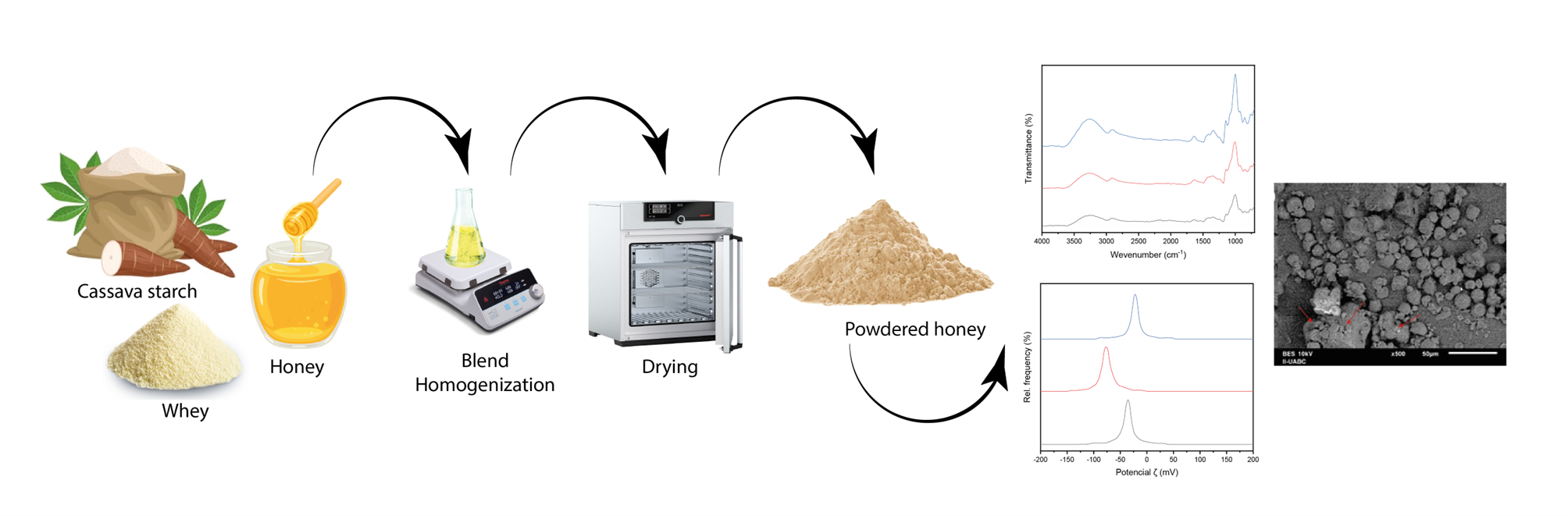
O mel é considerado um alimento nutritivo, produzido principalmente pelas abelhas (Apis mellifera L.) a partir do néctar das flores. No entanto, sua alta viscosidade e as dificuldades de manuseio impulsionaram o desenvolvimento da produção de mel em pó. O uso de adjuvantes como soro de leite e amido de mandioca, devido à sua versatilidade e disponibilidade, é uma opção viável para a produção de mel em pó. Portanto, misturas de mel, soro de leite e amido de mandioca foram avaliadas. As misturas foram secas em estufa de ar forçado a 60 °C por 24 h. Os pós resultantes foram caracterizados físico-quimicamente e analisados por FT-IR, DLS e MEV. A mistura com o maior teor de soro de leite apresentou uma tendência a diminuir ligeiramente os picos de absorção na faixa espectral de 1400 a 700 cm−1 na análise espectral de FT-IR. A estabilidade eletrostática apresentou valores de −34,7907 mV, um pico de distribuição de −35,3467 mV com condutividade de 0,0091 mS/cm e mobilidade eletroforética de −2,7116 µm*cm/Vs. A morfologia do pó resultante consistiu em partículas aglomeradas com grânulos de amido variando em tamanho de aproximadamente 45,7 a 90,2 µm. O soro do leite e o amido de mandioca são utilizados como adjuvantes e agentes estabilizantes na produção de mel em pó.
- Downloads
-
Os dados de download ainda não estão disponíveis.
- Referências
-
Allen, K. E., Carpenter, C. E., & Walsh, M. K. (2007). Influence of protein level and starch type on an extrusion‐expanded whey product. International Journal of Food Science & Technology, 42(8), 953–960. https://doi.org/10.1111/j.1365-2621.2006.01316.x DOI: https://doi.org/10.1111/j.1365-2621.2006.01316.x
AOAC. (2023). Official methods of analysis of AOAC International (22nd ed.). AOAC International.
Baglio, E. (2018). Honey: Processing Techniques and Treatments (pp. 15–22). https://doi.org/10.1007/978-3-319-65751-6_2 DOI: https://doi.org/10.1007/978-3-319-65751-6_2
Bravo-Núñez, Á., Garzón, R., Rosell, C. M., & Gómez, M. (2019). Evaluation of starch–protein interactions as a function of pH. Foods, 8(5), 155. https://doi.org/10.3390/foods8050155 DOI: https://doi.org/10.3390/foods8050155
Breuninger, W. F., Piyachomkwan, K., & Sriroth, K. (2009). Tapioca/cassava starch. In Starch (pp. 541–568). Elsevier. https://doi.org/10.1016/B978-0-12-746275-2.00012-4 DOI: https://doi.org/10.1016/B978-0-12-746275-2.00012-4
Britchenko, I., & Mickiewicz, B. (2022). Main trends and development forecast of bread and bakery products market. VUZF Review, 7(3), 113–123. https://doi.org/http://dx.doi.org/10.2139/ssrn.4235605 DOI: https://doi.org/10.38188/2534-9228.22.3.11
Chandrakar, N., Padhi, S., Saraugi, S. S., Sehrawat, R., Singh, A., & Routray, W. (2024). Whey protein and maltodextrin conjugated foam-mat dried honey powder: Functional, physicochemical, structural, rheological and thermal characterization. Chemical Engineering Research and Design, 209, 367–379. https://doi.org/10.1016/j.cherd.2024.08.015 DOI: https://doi.org/10.1016/j.cherd.2024.08.015
Chandrapala, J., Duke, M. C., Gray, S. R., Zisu, B., Weeks, M., Palmer, M., & Vasiljevic, T. (2015). Properties of acid whey as a function of pH and temperature. Journal of Dairy Science, 98(7), 4352–4363. https://doi.org/10.3168/jds.2015-9435 DOI: https://doi.org/10.3168/jds.2015-9435
Chaven, S. (2023). Confectionery and Bakery Products; Including Honey. In Food Safety Management (pp. 291–303). Elsevier. https://doi.org/10.1016/B978-0-12-820013-1.00045-0 DOI: https://doi.org/10.1016/B978-0-12-820013-1.00045-0
Dodds, J. (2024). Techniques to analyse particle size of food powders. In Handbook of Food Powders (pp. 249–268). Elsevier. https://doi.org/10.1016/B978-0-323-98820-9.00070-3 DOI: https://doi.org/10.1016/B978-0-323-98820-9.00070-3
Filomeni, G., Graziani, I., De Zio, D., Dini, L., Centonze, D., Rotilio, G., & Ciriolo, M. R. (2012). Neuroprotection of kaempferol by autophagy in models of rotenone-mediated acute toxicity: possible implications for Parkinson’s disease. Neurobiology of Aging, 33(4), 767–785. https://doi.org/10.1016/j.neurobiolaging.2010.05.021 DOI: https://doi.org/10.1016/j.neurobiolaging.2010.05.021
Hazlett, R., Schmidmeier, C., & O’Mahony, J. A. (2021). Approaches for improving the flowability of high-protein dairy powders post spray drying – A review. Powder Technology, 388, 26–40. https://doi.org/10.1016/j.powtec.2021.03.021 DOI: https://doi.org/10.1016/j.powtec.2021.03.021
He, R., Du, J., Feng, A., Zhang, J., Zhong, G., Fu, N., & Yang, T. (2025). Physical modification of cassava starch by alternating magnetic field treatment: Effects on fine structure, retrogradation and in vitro digestibility. Food Chemistry, 471, 142650. https://doi.org/10.1016/j.foodchem.2024.142650 DOI: https://doi.org/10.1016/j.foodchem.2024.142650
Ke, C., & Li, L. (2023). Influence mechanism of polysaccharides induced Maillard reaction on plant proteins structure and functional properties: A review. Carbohydrate Polymers, 302, 120430. https://doi.org/10.1016/j.carbpol.2022.120430 DOI: https://doi.org/10.1016/j.carbpol.2022.120430
Masyithoh, D., Jaya, F., Estiasih, T., Ira Febriani, S., Claudhia Falaq, E., & Kurniawan, F. (2025). Characterization of vacuum-dried honey powder: effect of honey type and carrier composition on functional, physicochemical, and antioxidant properties. International Journal of Food Properties, 28(1). https://doi.org/10.1080/10942912.2025.2557992 DOI: https://doi.org/10.1080/10942912.2025.2557992
Montes, C., Villaseñor, M. J., & Ríos, Á. (2019). Analytical control of nanodelivery lipid-based systems for encapsulation of nutraceuticals: Achievements and challenges. Trends in Food Science & Technology, 90, 47–62. https://doi.org/10.1016/j.tifs.2019.06.001 DOI: https://doi.org/10.1016/j.tifs.2019.06.001
Nabgan, M., Shariatifar, N., Jahed-Khaniki, G., Molaee-Aghaee, E., & Sani, M. A. (2025). Development and characterization of whey protein packaging film loaded with Pickering emulsion stabilized marjoram (Origanum majorana L.) essential oil. International Journal of Biological Macromolecules, 334, 149178. https://doi.org/10.1016/j.ijbiomac.2025.149178 DOI: https://doi.org/10.1016/j.ijbiomac.2025.149178
Pelegrine, D. H. G., & Gasparetto, C. A. (2005). Whey proteins solubility as function of temperature and pH. LWT - Food Science and Technology, 38(1), 77–80. https://doi.org/10.1016/j.lwt.2004.03.013 DOI: https://doi.org/10.1016/j.lwt.2004.03.013
Saji, R., Ramani, A., Gandhi, K., Seth, R., & Sharma, R. (2024). Application of FTIR spectroscopy in dairy products: A systematic review. Food and Humanity, 2, 100239. https://doi.org/10.1016/j.foohum.2024.100239 DOI: https://doi.org/10.1016/j.foohum.2024.100239
Samborska, K. (2019). Powdered honey – drying methods and parameters, types of carriers and drying aids, physicochemical properties and storage stability. Trends in Food Science & Technology, 88, 133–142. https://doi.org/10.1016/j.tifs.2019.03.019 DOI: https://doi.org/10.1016/j.tifs.2019.03.019
Samborska, K., Barańska-Dołomisiewicz, A., Jedlińska, A., Costa, R., Klimantakis, K., Mourtzinos, I., & Nowacka, M. (2025). Valorization of Spent Osmotic Solutions by Production of Powders by Spray Drying. Applied Sciences, 15(12), 6927. https://doi.org/10.3390/app15126927 DOI: https://doi.org/10.3390/app15126927
Santos, A. C. dos, Biluca, F. C., Braghini, F., Gonzaga, L. V., Costa, A. C. O., & Fett, R. (2021). Phenolic composition and biological activities of stingless bee honey: An overview based on its aglycone and glycoside compounds. Food Research International, 147, 110553. https://doi.org/10.1016/j.foodres.2021.110553 DOI: https://doi.org/10.1016/j.foodres.2021.110553
Saraugi, S. S., Chandrakar, N., Padhi, S., & Routray, W. (2026). Insights into honey powder production: Key factors, production methods, physicochemical characterization, and applications. Food Chemistry, 500, 147402. https://doi.org/10.1016/j.foodchem.2025.147402 DOI: https://doi.org/10.1016/j.foodchem.2025.147402
Sathivel, S. (2013). Application of honey powder in bread and its effect on bread characteristics. Journal of Food Processing & Technology, 04(11). https://doi.org/10.4172/2157-7110.1000279 DOI: https://doi.org/10.4172/2157-7110.1000279
Setiowati, A. D., Wijaya, W., & Van der Meeren, P. (2020). Whey protein-polysaccharide conjugates obtained via dry heat treatment to improve the heat stability of whey protein stabilized emulsions. Trends in Food Science & Technology, 98, 150–161. https://doi.org/10.1016/j.tifs.2020.02.011 DOI: https://doi.org/10.1016/j.tifs.2020.02.011
Simunkova, H., Pessenda-Garcia, P., Wosik, J., Angerer, P., Kronberger, H., & Nauer, G. E. (2009). The fundamentals of nano- and submicro-scaled ceramic particles incorporation into electrodeposited nickel layers: Zeta potential measurements. Surface and Coatings Technology, 203(13), 1806–1814. https://doi.org/10.1016/j.surfcoat.2008.12.031 DOI: https://doi.org/10.1016/j.surfcoat.2008.12.031
Soler, A., Dominguez-Ayala, J. E., Morales-Sánchez, E., Cabrera-Ramírez, Á. H., Sifuentes-Nieves, I., Velazquez, G., & Mendez-Montealvo, G. (2026). Unraveling the crystalline and double helical characteristics and their impact on the functionality of dry-heated cassava and corn starch. International Journal of Biological Macromolecules, 340, 150004. https://doi.org/10.1016/j.ijbiomac.2025.150004 DOI: https://doi.org/10.1016/j.ijbiomac.2025.150004
Suhag, Y., & Nanda, V. (2016). Optimization for spray drying process parameters of nutritionally rich honey powder using response surface methodology. Cogent Food & Agriculture, 2(1). https://doi.org/10.1080/23311932.2016.1176631 DOI: https://doi.org/10.1080/23311932.2016.1176631
Tenore, G. C., Ritieni, A., Campiglia, P., & Novellino, E. (2012). Nutraceutical potential of monofloral honeys produced by the Sicilian black honeybees (Apis mellifera ssp. sicula). Food and Chemical Toxicology, 50(6), 1955–1961. https://doi.org/10.1016/j.fct.2012.03.067 DOI: https://doi.org/10.1016/j.fct.2012.03.067
Tomczyk, M., Zaguła, G., Tarapatskyy, M., Kačániová, M., & Dżugan, M. (2021). The effect of honey variety on the quality of honey powder. Journal of Microbiology, Biotechnology and Food Sciences, 9(5), 949–954. https://doi.org/10.15414/jmbfs.2020.9.5.949-954 DOI: https://doi.org/10.15414/jmbfs.2020.9.5.949-954
Toniazzo, T., Collado-González, M., Tadini, C. C., & Mackie, A. R. (2023). Evaluation of physicochemical properties of honey powder using rice and pea proteins as carriers. Food Research International, 167, 112692. https://doi.org/10.1016/j.foodres.2023.112692 DOI: https://doi.org/10.1016/j.foodres.2023.112692
Torley, P. J., Rutgers, R. P. G., D’Arcy, B., & Bhandari, B. R. (2004). Effect of honey types and concentration on starch gelatinization. LWT - Food Science and Technology, 37(2), 161–170. https://doi.org/10.1016/j.lwt.2003.08.002 DOI: https://doi.org/10.1016/j.lwt.2003.08.002
Verma, D. K., Patel, A. R., Tripathy, S., Gupta, A. K., Singh, S., Shah, N., Utama, G. L., Chávez-González, M. L., Zongo, K., Banwo, K., Niamah, A. K., & Aguilar, C. N. (2024). Processing and formulation technology of nutritional and functional food products by utilizing cheese and/or paneer whey: A critical review. Journal of King Saud University - Science, 36(11), 103508. https://doi.org/10.1016/j.jksus.2024.103508 DOI: https://doi.org/10.1016/j.jksus.2024.103508
Vosoghi, M., Yousefi, S., & Honarvar, M. (2025). Physicochemical and sensory properties of honey powder from different climatic regions. Applied Food Research, 5(1), 100843. https://doi.org/10.1016/j.afres.2025.100843 DOI: https://doi.org/10.1016/j.afres.2025.100843
Wang, Z., Mhaske, P., Farahnaky, A., Kasapis, S., & Majzoobi, M. (2022). Cassava starch: Chemical modification and its impact on functional properties and digestibility, a review. Food Hydrocolloids, 129, 107542. https://doi.org/10.1016/j.foodhyd.2022.107542 DOI: https://doi.org/10.1016/j.foodhyd.2022.107542
Wu, Y., & Guo, Q. (2025). Effect of whey protein on the formation, structure and gastrointestinal breakdown of quinoa flour-based composite gels. Food Hydrocolloids, 160, 110775. https://doi.org/10.1016/j.foodhyd.2024.110775 DOI: https://doi.org/10.1016/j.foodhyd.2024.110775
Yadav, R., Aralkar, S., Prasad, K. V., Firake, D. M., Aradwad, P., Raju, D. V. S., & Kv, S. (2026). Trends in honey spray drying: A comprehensive analysis of drying conditions, process optimization, physicochemical properties, honey powder enrichment and industrial applications. Trends in Food Science & Technology, 168, 105508. https://doi.org/10.1016/j.tifs.2025.105508 DOI: https://doi.org/10.1016/j.tifs.2025.105508
Yamul, D. K., & Lupano, C. E. (2005). Whey protein concentrate gels with honey and wheat flour. Food Research International, 38(5), 511–522. https://doi.org/10.1016/j.foodres.2004.11.005 DOI: https://doi.org/10.1016/j.foodres.2004.11.005
Zhang, J., Liu, Y., Wang, P., Zhao, Y., Zhu, Y., & Xiao, X. (2025). The Effect of Protein–Starch Interaction on the Structure and Properties of Starch, and Its Application in Flour Products. Foods, 14(5), 778. https://doi.org/10.3390/foods14050778 DOI: https://doi.org/10.3390/foods14050778
Zhang, X., Wang, Q., Liu, Z., Zhi, L., Jiao, B., Hu, H., Ma, X., Agyei, D., & Shi, A. (2023). Plant protein-based emulsifiers: Mechanisms, techniques for emulsification enhancement and applications. Food Hydrocolloids, 144, 109008. https://doi.org/10.1016/j.foodhyd.2023.109008 DOI: https://doi.org/10.1016/j.foodhyd.2023.109008
Zhen, Y., Wang, K., Wang, J., Qiao, D., Zhao, S., Lin, Q., & Zhang, B. (2022). Increasing the pH value during thermal processing suppresses the starch digestion of the resulting starch-protein-lipid complexes. Carbohydrate Polymers, 278, 118931. https://doi.org/10.1016/j.carbpol.2021.118931 DOI: https://doi.org/10.1016/j.carbpol.2021.118931
Zhu, F. (2015). Interactions between starch and phenolic compound. Trends in Food Science & Technology, 43(2), 129–143. https://doi.org/10.1016/j.tifs.2015.02.003 DOI: https://doi.org/10.1016/j.tifs.2015.02.003
- Cover Image
-
- Downloads
- Publicado
- 2026-02-28
- Edição
- v. 5 n. 1 (2026)
- Seção
- Artigo Original
- Licença
-
Direitos autorais (c) 2026 Ulin Antobelli Basilio-Cortes, Daniel González-Mendoza, Dagoberto Durán-Hernández, Alexis Alejandro Salazar-Navarro, Benjamín Valdez-Salas, Ernesto Beltrán-Partida, José Gregorio Joya-Dávila, Lourdes González-Salitre

Este trabalho está licenciado sob uma licença Creative Commons Attribution 4.0 International License.
Esta revista publica seus artigos em Acesso Aberto sob licença Creative Commons (CC BY 4.0).
Você é livre para:
Compartilhar — copie e redistribua o material em qualquer meio ou formato para qualquer finalidade, inclusive comercial.
Adaptar – remixar, transformar e desenvolver o material para qualquer finalidade, até mesmo comercial.
O licenciante não pode revogar essas liberdades desde que você siga os termos da licença.
Nos seguintes termos:
Atribuição — Você deve dar o devido crédito, fornecer um link para a licença e indicar se foram feitas alterações. Você pode fazê-lo de qualquer maneira razoável, mas não de forma que sugira que o licenciante endossa você ou seu uso.
Sem restrições adicionais — Você não pode aplicar termos legais ou medidas tecnológicas que restrinjam legalmente outras pessoas de fazerem qualquer coisa que a licença permita.
Avisos:
Você não precisa cumprir a licença para elementos do material de domínio público ou onde seu uso for permitido por uma exceção ou limitação aplicável.Nenhuma garantia é dada. A licença pode não conceder todas as permissões necessárias para o uso pretendido. Por exemplo, outros direitos, como publicidade, privacidade ou direitos morais, podem limitar a forma como você utiliza o material.

Como Citar




Artigos Semelhantes
- Laryssa Ana Alexandre, Luana Carolina Bosmuler Zuge, Desenvolvimento e aplicação em morangos de revestimentos comestíveis baseados em inhame e amido de milho adicionados com cereja do Rio Grande , Food Science Today: v. 1 n. 1 (2023)
- Armando Mateus Moiana, Chaid Acácio António Mussalafo, Jausse Elias Camunacossa, Inocêncio Collor de Melo Horácio, Desenvolvimento de farinha à base da fruta-pão (Artocarpus altilis) enriquecida com fécula da mandioca (Manihot esculenta) e farinha de amendoim torrado (Arachis hypogaea L) , Food Science Today: v. 5 n. 1 (2026)
- Itzury Reyes-Ramírez, Jesús Guadalupe Pérez-Flores , Laura García-Curiel , Luis Guillermo González-Olivares , Elizabeth Contreras-López , Laura Berenice Olvera-Rosales , Emmanuel Pérez-Escalante, Produção científica sobre hidrólise enzimática do soro de leite bovino e seus peptídeos bioativos: Uma abordagem bibliométrica , Food Science Today: v. 4 n. 1 (2025)
- Luis Alberto Mendoza-Flores, Jesús Guadalupe Pérez Flores, Laura García-Curiel, Alma Elizabeth Cruz-Guerrero, Emmanuel Pérez-Escalante, Elizabeth Contreras-López, Luis Guillermo González-Olivares, Soro de leite como ingrediente funcional na indústria alimentícia: um estudo bibliométrico sobre seu potencial e inovação , Food Science Today: v. 4 n. 1 (2025)
- Luis Eduardo Zúñiga-Moreno, María José Briones Ramos, Doris Guilcamaigua-Anchatuña, Edgar Fernando Landines, Uso de kiwi (Actinidia deliciosa), quinoa (Chenopodium quinoa) e casca de melancia (Citrullus lanatus) em uma bebida à base de plantas , Food Science Today: v. 3 n. 1 (2024)
- Bruno Luís Ferreira, Vitória Feilstrecker Bohn, Lissandra Waltrich, Jane Mara Block, Daniel Granato, Itaciara Larroza Nunes, Extração assistida por ultrassom utilizando o líquido iônico [BMIM][Cl] como método eficaz para recuperar compostos fenólicos do coproduto do processamento da goiaba , Food Science Today: v. 1 n. 1 (2023)
- Vinicius Nelson Barboza de Souza, Nathaly Calister Moretto, Igor Gabriel Silva Oliveira, Caroline Pereira Moura Aranha, Silvia Maria Martelli, Aplicação de revestimentos comestíveis contendo óleos essenciais em laranja ‘Pêra’ (Citrus sinensis L. Osbeck) , Food Science Today: v. 3 n. 1 (2024)
- Luisa Martins Simmer, Sustentabilidade ambiental e o sistema alimentar na perspectiva do nutricionista , Food Science Today: v. 3 n. 1 (2024)
Você também pode iniciar uma pesquisa avançada por similaridade para este artigo.