
Effect of whey and cassava starch on the production of honey powder: Spectroscopic and morphological analysis
- Authors
-
-
Ulin Antobelli Basilio-Cortes
Universidad Autónoma de Baja California
-
Daniel González-Mendoza
Universidad Autónoma de Baja California
-
Dagoberto Durán-Hernández
Universidad Autónoma de Baja California
-
Alexis Alejandro Salazar-Navarro
Universidad Autónoma de Baja California
-
Benjamín Valdez-Salas
Universidad Autónoma de Baja California
-
Ernesto Beltrán-Partida
Universidad Autónoma de Baja California
-
José Gregorio Joya-Dávila
Universidad Autónoma de Baja California
-
Lourdes González-Salitre
Universidad Autónoma de Baja California
-
- Keywords:
- Honey, Whey, Cassava starch, FT-IR, DLS, SEM
- Abstract
-
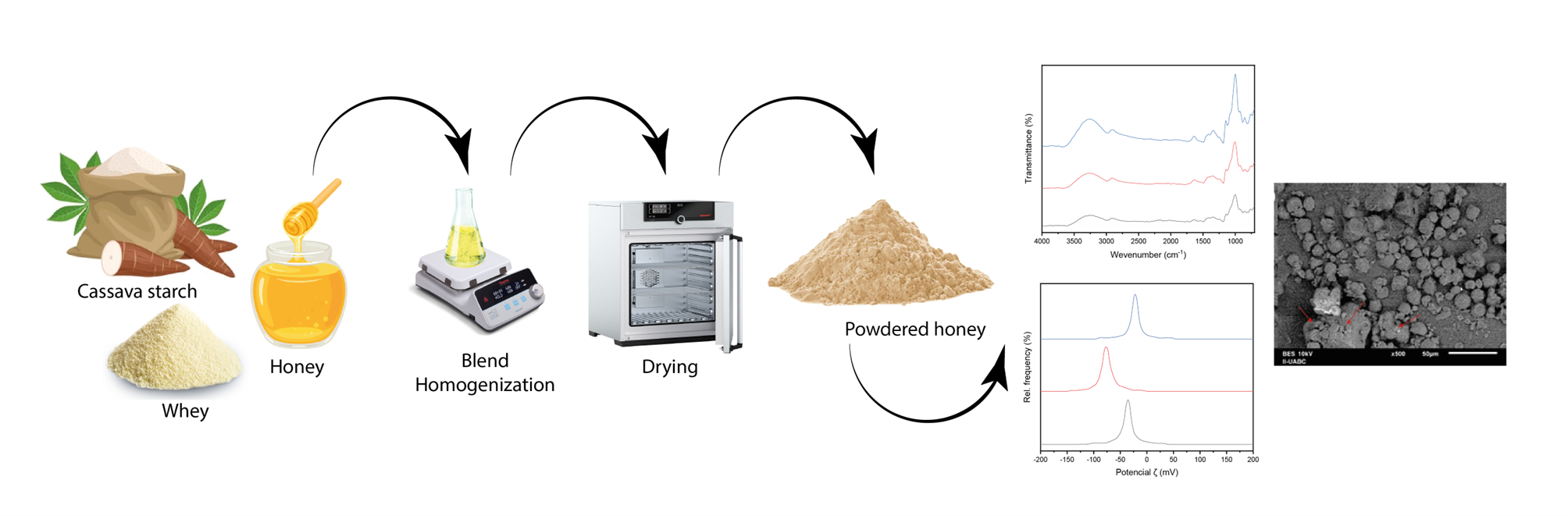
Honey is considered a nutritious food, produced primarily by bees (Apis mellifera L.) from flower nectar. However, its high viscosity and handling difficulties have driven the development of honey powder production. The use of adjuvants such as whey and cassava starch, due to their versatility and availability, is a viable option for honey powder production. Therefore, mixtures of honey, whey, and cassava starch were evaluated. The mixtures were dried in a forced air oven at 60 °C for 24 h. The resulting powders were physicochemically characterized and analyzed by FT-IR, DLS, and SEM. The mixture with the highest whey content showed a tendency to slightly decrease the absorption peaks in the spectral range of 1400 to 700 cm−1 in FT-IR spectral analysis. The electrostatic stability showed values of −34.7907 mV, a peak distribution of −35.3467 mV with a conductivity of 0.0091 mS/cm and an electrophoretic mobility of −2.7116 µm*cm/Vs. The morphology of the resulting powder consisted of agglomerated particles with starch granules ranging in size from approximately 45.7 to 90.2 µm. Whey and cassava starch are used as additives and stabilizing agents to produce powdered honey.
- Downloads
-
Download data is not yet available.
- References
-
Allen, K. E., Carpenter, C. E., & Walsh, M. K. (2007). Influence of protein level and starch type on an extrusion‐expanded whey product. International Journal of Food Science & Technology, 42(8), 953–960. https://doi.org/10.1111/j.1365-2621.2006.01316.x DOI: https://doi.org/10.1111/j.1365-2621.2006.01316.x
AOAC. (2023). Official methods of analysis of AOAC International (22nd ed.). AOAC International.
Baglio, E. (2018). Honey: Processing Techniques and Treatments (pp. 15–22). https://doi.org/10.1007/978-3-319-65751-6_2 DOI: https://doi.org/10.1007/978-3-319-65751-6_2
Bravo-Núñez, Á., Garzón, R., Rosell, C. M., & Gómez, M. (2019). Evaluation of starch–protein interactions as a function of pH. Foods, 8(5), 155. https://doi.org/10.3390/foods8050155 DOI: https://doi.org/10.3390/foods8050155
Breuninger, W. F., Piyachomkwan, K., & Sriroth, K. (2009). Tapioca/cassava starch. In Starch (pp. 541–568). Elsevier. https://doi.org/10.1016/B978-0-12-746275-2.00012-4 DOI: https://doi.org/10.1016/B978-0-12-746275-2.00012-4
Britchenko, I., & Mickiewicz, B. (2022). Main trends and development forecast of bread and bakery products market. VUZF Review, 7(3), 113–123. https://doi.org/http://dx.doi.org/10.2139/ssrn.4235605 DOI: https://doi.org/10.38188/2534-9228.22.3.11
Chandrakar, N., Padhi, S., Saraugi, S. S., Sehrawat, R., Singh, A., & Routray, W. (2024). Whey protein and maltodextrin conjugated foam-mat dried honey powder: Functional, physicochemical, structural, rheological and thermal characterization. Chemical Engineering Research and Design, 209, 367–379. https://doi.org/10.1016/j.cherd.2024.08.015 DOI: https://doi.org/10.1016/j.cherd.2024.08.015
Chandrapala, J., Duke, M. C., Gray, S. R., Zisu, B., Weeks, M., Palmer, M., & Vasiljevic, T. (2015). Properties of acid whey as a function of pH and temperature. Journal of Dairy Science, 98(7), 4352–4363. https://doi.org/10.3168/jds.2015-9435 DOI: https://doi.org/10.3168/jds.2015-9435
Chaven, S. (2023). Confectionery and Bakery Products; Including Honey. In Food Safety Management (pp. 291–303). Elsevier. https://doi.org/10.1016/B978-0-12-820013-1.00045-0 DOI: https://doi.org/10.1016/B978-0-12-820013-1.00045-0
Dodds, J. (2024). Techniques to analyse particle size of food powders. In Handbook of Food Powders (pp. 249–268). Elsevier. https://doi.org/10.1016/B978-0-323-98820-9.00070-3 DOI: https://doi.org/10.1016/B978-0-323-98820-9.00070-3
Filomeni, G., Graziani, I., De Zio, D., Dini, L., Centonze, D., Rotilio, G., & Ciriolo, M. R. (2012). Neuroprotection of kaempferol by autophagy in models of rotenone-mediated acute toxicity: possible implications for Parkinson’s disease. Neurobiology of Aging, 33(4), 767–785. https://doi.org/10.1016/j.neurobiolaging.2010.05.021 DOI: https://doi.org/10.1016/j.neurobiolaging.2010.05.021
Hazlett, R., Schmidmeier, C., & O’Mahony, J. A. (2021). Approaches for improving the flowability of high-protein dairy powders post spray drying – A review. Powder Technology, 388, 26–40. https://doi.org/10.1016/j.powtec.2021.03.021 DOI: https://doi.org/10.1016/j.powtec.2021.03.021
He, R., Du, J., Feng, A., Zhang, J., Zhong, G., Fu, N., & Yang, T. (2025). Physical modification of cassava starch by alternating magnetic field treatment: Effects on fine structure, retrogradation and in vitro digestibility. Food Chemistry, 471, 142650. https://doi.org/10.1016/j.foodchem.2024.142650 DOI: https://doi.org/10.1016/j.foodchem.2024.142650
Ke, C., & Li, L. (2023). Influence mechanism of polysaccharides induced Maillard reaction on plant proteins structure and functional properties: A review. Carbohydrate Polymers, 302, 120430. https://doi.org/10.1016/j.carbpol.2022.120430 DOI: https://doi.org/10.1016/j.carbpol.2022.120430
Masyithoh, D., Jaya, F., Estiasih, T., Ira Febriani, S., Claudhia Falaq, E., & Kurniawan, F. (2025). Characterization of vacuum-dried honey powder: effect of honey type and carrier composition on functional, physicochemical, and antioxidant properties. International Journal of Food Properties, 28(1). https://doi.org/10.1080/10942912.2025.2557992 DOI: https://doi.org/10.1080/10942912.2025.2557992
Montes, C., Villaseñor, M. J., & Ríos, Á. (2019). Analytical control of nanodelivery lipid-based systems for encapsulation of nutraceuticals: Achievements and challenges. Trends in Food Science & Technology, 90, 47–62. https://doi.org/10.1016/j.tifs.2019.06.001 DOI: https://doi.org/10.1016/j.tifs.2019.06.001
Nabgan, M., Shariatifar, N., Jahed-Khaniki, G., Molaee-Aghaee, E., & Sani, M. A. (2025). Development and characterization of whey protein packaging film loaded with Pickering emulsion stabilized marjoram (Origanum majorana L.) essential oil. International Journal of Biological Macromolecules, 334, 149178. https://doi.org/10.1016/j.ijbiomac.2025.149178 DOI: https://doi.org/10.1016/j.ijbiomac.2025.149178
Pelegrine, D. H. G., & Gasparetto, C. A. (2005). Whey proteins solubility as function of temperature and pH. LWT - Food Science and Technology, 38(1), 77–80. https://doi.org/10.1016/j.lwt.2004.03.013 DOI: https://doi.org/10.1016/j.lwt.2004.03.013
Saji, R., Ramani, A., Gandhi, K., Seth, R., & Sharma, R. (2024). Application of FTIR spectroscopy in dairy products: A systematic review. Food and Humanity, 2, 100239. https://doi.org/10.1016/j.foohum.2024.100239 DOI: https://doi.org/10.1016/j.foohum.2024.100239
Samborska, K. (2019). Powdered honey – drying methods and parameters, types of carriers and drying aids, physicochemical properties and storage stability. Trends in Food Science & Technology, 88, 133–142. https://doi.org/10.1016/j.tifs.2019.03.019 DOI: https://doi.org/10.1016/j.tifs.2019.03.019
Samborska, K., Barańska-Dołomisiewicz, A., Jedlińska, A., Costa, R., Klimantakis, K., Mourtzinos, I., & Nowacka, M. (2025). Valorization of Spent Osmotic Solutions by Production of Powders by Spray Drying. Applied Sciences, 15(12), 6927. https://doi.org/10.3390/app15126927 DOI: https://doi.org/10.3390/app15126927
Santos, A. C. dos, Biluca, F. C., Braghini, F., Gonzaga, L. V., Costa, A. C. O., & Fett, R. (2021). Phenolic composition and biological activities of stingless bee honey: An overview based on its aglycone and glycoside compounds. Food Research International, 147, 110553. https://doi.org/10.1016/j.foodres.2021.110553 DOI: https://doi.org/10.1016/j.foodres.2021.110553
Saraugi, S. S., Chandrakar, N., Padhi, S., & Routray, W. (2026). Insights into honey powder production: Key factors, production methods, physicochemical characterization, and applications. Food Chemistry, 500, 147402. https://doi.org/10.1016/j.foodchem.2025.147402 DOI: https://doi.org/10.1016/j.foodchem.2025.147402
Sathivel, S. (2013). Application of honey powder in bread and its effect on bread characteristics. Journal of Food Processing & Technology, 04(11). https://doi.org/10.4172/2157-7110.1000279 DOI: https://doi.org/10.4172/2157-7110.1000279
Setiowati, A. D., Wijaya, W., & Van der Meeren, P. (2020). Whey protein-polysaccharide conjugates obtained via dry heat treatment to improve the heat stability of whey protein stabilized emulsions. Trends in Food Science & Technology, 98, 150–161. https://doi.org/10.1016/j.tifs.2020.02.011 DOI: https://doi.org/10.1016/j.tifs.2020.02.011
Simunkova, H., Pessenda-Garcia, P., Wosik, J., Angerer, P., Kronberger, H., & Nauer, G. E. (2009). The fundamentals of nano- and submicro-scaled ceramic particles incorporation into electrodeposited nickel layers: Zeta potential measurements. Surface and Coatings Technology, 203(13), 1806–1814. https://doi.org/10.1016/j.surfcoat.2008.12.031 DOI: https://doi.org/10.1016/j.surfcoat.2008.12.031
Soler, A., Dominguez-Ayala, J. E., Morales-Sánchez, E., Cabrera-Ramírez, Á. H., Sifuentes-Nieves, I., Velazquez, G., & Mendez-Montealvo, G. (2026). Unraveling the crystalline and double helical characteristics and their impact on the functionality of dry-heated cassava and corn starch. International Journal of Biological Macromolecules, 340, 150004. https://doi.org/10.1016/j.ijbiomac.2025.150004 DOI: https://doi.org/10.1016/j.ijbiomac.2025.150004
Suhag, Y., & Nanda, V. (2016). Optimization for spray drying process parameters of nutritionally rich honey powder using response surface methodology. Cogent Food & Agriculture, 2(1). https://doi.org/10.1080/23311932.2016.1176631 DOI: https://doi.org/10.1080/23311932.2016.1176631
Tenore, G. C., Ritieni, A., Campiglia, P., & Novellino, E. (2012). Nutraceutical potential of monofloral honeys produced by the Sicilian black honeybees (Apis mellifera ssp. sicula). Food and Chemical Toxicology, 50(6), 1955–1961. https://doi.org/10.1016/j.fct.2012.03.067 DOI: https://doi.org/10.1016/j.fct.2012.03.067
Tomczyk, M., Zaguła, G., Tarapatskyy, M., Kačániová, M., & Dżugan, M. (2021). The effect of honey variety on the quality of honey powder. Journal of Microbiology, Biotechnology and Food Sciences, 9(5), 949–954. https://doi.org/10.15414/jmbfs.2020.9.5.949-954 DOI: https://doi.org/10.15414/jmbfs.2020.9.5.949-954
Toniazzo, T., Collado-González, M., Tadini, C. C., & Mackie, A. R. (2023). Evaluation of physicochemical properties of honey powder using rice and pea proteins as carriers. Food Research International, 167, 112692. https://doi.org/10.1016/j.foodres.2023.112692 DOI: https://doi.org/10.1016/j.foodres.2023.112692
Torley, P. J., Rutgers, R. P. G., D’Arcy, B., & Bhandari, B. R. (2004). Effect of honey types and concentration on starch gelatinization. LWT - Food Science and Technology, 37(2), 161–170. https://doi.org/10.1016/j.lwt.2003.08.002 DOI: https://doi.org/10.1016/j.lwt.2003.08.002
Verma, D. K., Patel, A. R., Tripathy, S., Gupta, A. K., Singh, S., Shah, N., Utama, G. L., Chávez-González, M. L., Zongo, K., Banwo, K., Niamah, A. K., & Aguilar, C. N. (2024). Processing and formulation technology of nutritional and functional food products by utilizing cheese and/or paneer whey: A critical review. Journal of King Saud University - Science, 36(11), 103508. https://doi.org/10.1016/j.jksus.2024.103508 DOI: https://doi.org/10.1016/j.jksus.2024.103508
Vosoghi, M., Yousefi, S., & Honarvar, M. (2025). Physicochemical and sensory properties of honey powder from different climatic regions. Applied Food Research, 5(1), 100843. https://doi.org/10.1016/j.afres.2025.100843 DOI: https://doi.org/10.1016/j.afres.2025.100843
Wang, Z., Mhaske, P., Farahnaky, A., Kasapis, S., & Majzoobi, M. (2022). Cassava starch: Chemical modification and its impact on functional properties and digestibility, a review. Food Hydrocolloids, 129, 107542. https://doi.org/10.1016/j.foodhyd.2022.107542 DOI: https://doi.org/10.1016/j.foodhyd.2022.107542
Wu, Y., & Guo, Q. (2025). Effect of whey protein on the formation, structure and gastrointestinal breakdown of quinoa flour-based composite gels. Food Hydrocolloids, 160, 110775. https://doi.org/10.1016/j.foodhyd.2024.110775 DOI: https://doi.org/10.1016/j.foodhyd.2024.110775
Yadav, R., Aralkar, S., Prasad, K. V., Firake, D. M., Aradwad, P., Raju, D. V. S., & Kv, S. (2026). Trends in honey spray drying: A comprehensive analysis of drying conditions, process optimization, physicochemical properties, honey powder enrichment and industrial applications. Trends in Food Science & Technology, 168, 105508. https://doi.org/10.1016/j.tifs.2025.105508 DOI: https://doi.org/10.1016/j.tifs.2025.105508
Yamul, D. K., & Lupano, C. E. (2005). Whey protein concentrate gels with honey and wheat flour. Food Research International, 38(5), 511–522. https://doi.org/10.1016/j.foodres.2004.11.005 DOI: https://doi.org/10.1016/j.foodres.2004.11.005
Zhang, J., Liu, Y., Wang, P., Zhao, Y., Zhu, Y., & Xiao, X. (2025). The Effect of Protein–Starch Interaction on the Structure and Properties of Starch, and Its Application in Flour Products. Foods, 14(5), 778. https://doi.org/10.3390/foods14050778 DOI: https://doi.org/10.3390/foods14050778
Zhang, X., Wang, Q., Liu, Z., Zhi, L., Jiao, B., Hu, H., Ma, X., Agyei, D., & Shi, A. (2023). Plant protein-based emulsifiers: Mechanisms, techniques for emulsification enhancement and applications. Food Hydrocolloids, 144, 109008. https://doi.org/10.1016/j.foodhyd.2023.109008 DOI: https://doi.org/10.1016/j.foodhyd.2023.109008
Zhen, Y., Wang, K., Wang, J., Qiao, D., Zhao, S., Lin, Q., & Zhang, B. (2022). Increasing the pH value during thermal processing suppresses the starch digestion of the resulting starch-protein-lipid complexes. Carbohydrate Polymers, 278, 118931. https://doi.org/10.1016/j.carbpol.2021.118931 DOI: https://doi.org/10.1016/j.carbpol.2021.118931
Zhu, F. (2015). Interactions between starch and phenolic compound. Trends in Food Science & Technology, 43(2), 129–143. https://doi.org/10.1016/j.tifs.2015.02.003 DOI: https://doi.org/10.1016/j.tifs.2015.02.003
- Cover Image
-
- Downloads
- Published
- 2026-02-28
- Issue
- Vol. 5 No. 1 (2026)
- Section
- Research Article
- License
-
Copyright (c) 2026 Ulin Antobelli Basilio-Cortes, Daniel González-Mendoza, Dagoberto Durán-Hernández, Alexis Alejandro Salazar-Navarro, Benjamín Valdez-Salas, Ernesto Beltrán-Partida, José Gregorio Joya-Dávila, Lourdes González-Salitre

This work is licensed under a Creative Commons Attribution 4.0 International License.
This journal publishes its Open Access articles under a Creative Commons license (CC BY 4.0).
You are free to:
Share — copy and redistribute the material in any medium or format for any purpose, even commercially.
Adapt — remix, transform, and build upon the material for any purpose, even commercially.
The licensor cannot revoke these freedoms as long as you follow the license terms.Under the following terms:
Attribution — You must give appropriate credit, provide a link to the license, and indicate if changes were made. You may do so in any reasonable manner, but not in any way that suggests the licensor endorses you or your use.No additional restrictions — You may not apply legal terms or technological measures that legally restrict others from doing anything the license permits.
Notices:
You do not have to comply with the license for elements of the material in the public domain or where your use is permitted by an applicable exception or limitation.No warranties are given. The license may not give you all of the permissions necessary for your intended use. For example, other rights such as publicity, privacy, or moral rights may limit how you use the material.

How to Cite




Similar Articles
- Laryssa Ana Alexandre, Luana Carolina Bosmuler Zuge, Development and application on strawberries of edible coatings based on yam and corn starch added with Rio Grande cherry , Food Science Today: Vol. 1 No. 1 (2023)
- Armando Mateus Moiana, Chaid Acácio António Mussalafo, Jausse Elias Camunacossa, Inocêncio Collor de Melo Horácio, Development of flour based on breadfruit (Artocarpus altilis) enriched with cassava starch (Manihot esculenta) and roasted peanut flour (Arachis hypogaea L) , Food Science Today: Vol. 5 No. 1 (2026)
- Itzury Reyes-Ramírez, Jesús Guadalupe Pérez-Flores , Laura García-Curiel , Luis Guillermo González-Olivares , Elizabeth Contreras-López , Laura Berenice Olvera-Rosales , Emmanuel Pérez-Escalante, Scientific production on enzymatic hydrolysis of bovine whey and its bioactive peptides: A bibliometric approach , Food Science Today: Vol. 4 No. 1 (2025)
- Luis Alberto Mendoza-Flores, Jesús Guadalupe Pérez-Flores, Laura García-Curiel, Alma Elizabeth Cruz-Guerrero, Emmanuel Pérez-Escalante, Elizabeth Contreras-López, Luis Guillermo González-Olivares, Whey as a functional ingredient in the food industry: a bibliometric study on its potential and innovation , Food Science Today: Vol. 4 No. 1 (2025)
- Luis Eduardo Zúñiga-Moreno, María José Briones Ramos, Doris Guilcamaigua-Anchatuña, Edgar Fernando Landines, Using kiwi (Actinidia deliciosa), quinoa (Chenopodium quinoa), and watermelon rind (Citrullus lanatus) in a plant-based drink , Food Science Today: Vol. 3 No. 1 (2024)
- Bruno Luís Ferreira, Vitória Feilstrecker Bohn, Lissandra Waltrich, Jane Mara Block, Daniel Granato, Itaciara Larroza Nunes, Ultrasound-assisted extraction using [BMIM][Cl] ionic liquid as an effective method for recovering phenolic compounds from the coproduct of guava processing , Food Science Today: Vol. 1 No. 1 (2023)
- Vinicius Nelson Barboza de Souza, Nathaly Calister Moretto, Igor Gabriel Silva Oliveira, Caroline Pereira Moura Aranha, Silvia Maria Martelli, Application of edible coatings containing essential oils in 'Pera' orange (Citrus sinensis L. Osbeck) , Food Science Today: Vol. 3 No. 1 (2024)
- Luisa Martins Simmer, Environmental sustainability and the food system from the nutritionist’s perspective , Food Science Today: Vol. 3 No. 1 (2024)
You may also start an advanced similarity search for this article.