
Development and physicochemical analysis of vegetarian burger enriched with quinoa, chia and beetroot
- Authors
-
-
- Keywords:
- New products, Vegetarian burger, Nutrients, Physicochemical analysis, Vegetarian diets
- Abstract
-
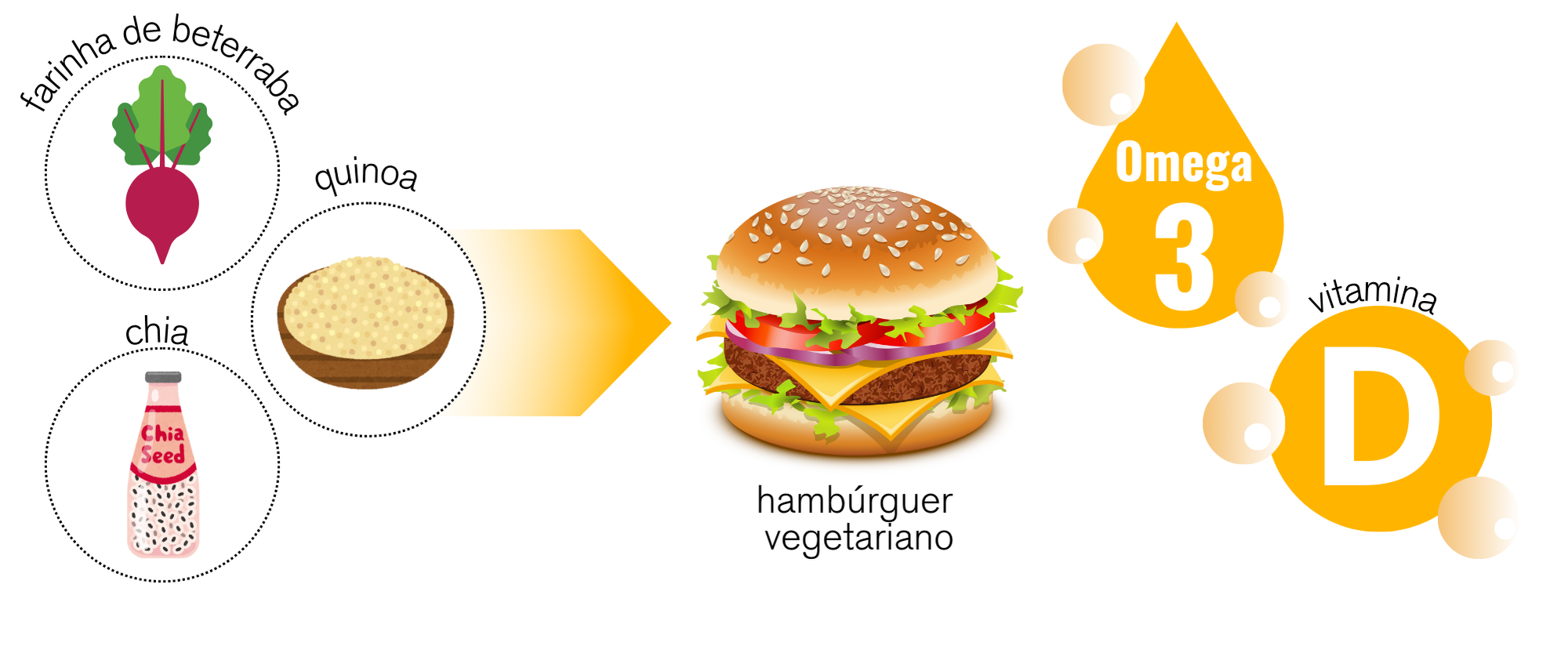
This study aimed to develop a vegetarian burger made with quinoa, chia, and beetroot flour, enriched with essential nutrients such as vitamin D and omega-3, to meet the nutritional needs of individuals who avoid meat consumption. Vegetarian diets often lack certain nutrients, making this product a potential solution to improve nutritional intake. The methodology involved a literature review from databases such as Scielo, Pubmed, Science Direct, Lilacs, Web of Science, and Periódicos CAPES, followed by the practical development and testing of the burger in a laboratory setting. Analytical methods were used to evaluate the nutritional content, including proteins, carbohydrates, lipids, and fibers, using techniques such as the Kjeldahl method and Soxhlet extraction. The results showed that the developed burger had a higher carbohydrate content and lower protein, and fat levels compared to other vegetarian burgers on the market. The discussion highlights the burger's benefits, such as the absence of additives and high fiber content, making it a healthier alternative. In conclusion, the vegetarian burger was well received, indicating its viability as a nutritious and appealing option for those following a vegetarian diet, potentially playing an important role in addressing dietary deficiencies and aligning with the growing trend toward plant-based foods.
- Downloads
-
Download data is not yet available.
- References
-
Amorim, P. S. (2015). Desenvolvimento e avaliação da aceitação de brownies sem glúten a partir da beterraba com cobertura de sementes de chia. 51 p. Trabalho de Conclusão de Curso, Bacharelado em Nutrição. Universidade Federal de Campina Grande, Campina Grande, PB.
Andrade, E. A. F. de, Sant’Anna, L. C., Almeida, N. D. C., Venturi, I., Brustulim, L. J. R., & D’Almeida, W. O. (2018). L-Triptofano, ômega 3, magnésio e vitaminas do complexo B na diminuição dos sintomas de ansiedade. Id on line Revista de Psicologia, 12(40), 1129–1138. https://doi.org/10.14295/idonline.v12i40.1165
Besson, T., Bouxom, H., & Jaubert, T. (2020). Halo it’s meat! The effect of the vegetarian label on calorie perception and food choices. Ecology of Food and Nutrition, 59(1), 3–20. https://doi.org/10.1080/03670244.2019.1652820
Boukid, F., & Castellari, M. (2021). Veggie burgers in the EU market: a nutritional challenge? European Food Research and Technology, 247(10), 2445–2453. https://doi.org/10.1007/s00217-021-03808-9
Brasil. (2020). Instrução Normativa – IN n° 75 da Agência Nacional de Vigilância Sanitária, de 8 de outubro de 2020. Estabelece os requisitos técnicos para declaração da rotulagem nutricional nos alimentos embalados. ANVISA.
Cavalheiro, C. A., Verdu, F. C., & Amarante, J. M. (2018). Difusão do vegetarianismo e veganismo no Brasil a partir de uma perspectiva de transnacionalização. Revista Eletrônica Ciências Da Administração e Turismo, 6(1), 51–67.
Crocetti, A., Ogleari, C. H., Gomes, G., Sare, I., Campos, F. R., & Balbi, M. E. (2017). Determinação da composição centesimal a partir de dois métodos de secagem para a produção da farinha de beterraba (Beta vulgaris, L. - Família Amaranthaceae). Visão Acadêmica, 17(4). https://doi.org/10.5380/acd.v17i4.51359
Ferreira, L. et al. (2017). Estudo de diferentes metodologias para quantificação de betalaína de beterraba, 3º Congresso Internacional de Atividade Física, Nutrição e Saúde, 1, 14-19. https://eventos.set.edu.br/CIAFIS/article/download/6386/2708
Ferreira, L. P. C., Xavier, A. C. R., Santos, J. dos, Wartha, E. R. S. de A., & Pagani, A. A. C. (2017). Estudo de Diferentes Metodologias para Quantificação de Betalaína de Beterraba. 3o Congresso Inte Rnacional de Atividade Física, Nutrição e Saúde, 1(1), 14–19.
Instituto Adolfo Lutz. (2008). Procedimentos e determinações gerais. In O. Zenebon, N. S. Pascuet, & P. Tiglea (Eds.), Métodos Físico-Químicos para Análise de Alimentos (1a ed., pp. 83–158). Instituto Adolfo Lutz.
Lange, F., Cnudde, M., & Maesen, H. (2023). Using prosocial incentives to promote vegetarian food choices: A field experiment. Food Quality and Preference, 106, 104812. https://doi.org/10.1016/j.foodqual.2023.104812
Lima, F., Menezes, B., Menezes, M. (2017). Avaliação do conhecimento alimentar e nutricional dos vegetarianos. Anais da X Mostra Científica FAMEZ/UFMS, Universidade Federal de Mato Grosso do Sul, Campo Grande, MS.
Linhares, A. O., & Cesar, J. A. (2017). Suplementação com ácido fólico entre gestantes no extremo Sul do Brasil: prevalência e fatores associados. Ciência & Saúde Coletiva, 22(2), 535–542. https://doi.org/10.1590/1413-81232017222.06302016
Lira, K. H. D. S. (2019). Nanoencapsulação em gelatina suína e proteína do soro do leite isolada aumenta a solubilidade de óleo de quinoa (Chenopudium quinoa) obtida por via biotecnológica. 83 p. Dissertação (Mestrado em Nutrição) – Universidade Federal do Rio Grande do Norte, Natal, RN.
Marques, G. D., Maia, H. de A. O., & Horta, P. M. do V. (2019). Hambúrguer: o fast food inspirando a gastronomia brasileira. Revista de Gastronomia, 1, 1--15.
Mazumder, M. A. R., Panpipat, W., Chaijan, M., Shetty, K., & Rawdkuen, S. (2023). Role of plant protein on the quality and structure of meat analogs: A new perspective for vegetarian foods. Future Foods, 8, 100280. https://doi.org/10.1016/j.fufo.2023.100280
Moraes, F. P., & Colla, L. M. (2006). Alimentos funcionais e nutracêuticos: definições, legislação e benefícios à saúde. Revista Eletrônica de Farmácia, 3(2), 109–122.
Moreira, T. B., Araújo, A. G., Basílio, D. L., Passos, X. S., & Rêde, A. K. I. (2016). Vitaminas lipossolúveis e seus benefícios. Eletronic Journal of Pharmacy, 12, 31–32.
Oliveira, N. M. de. (2020). Estudo dos principais ingredientes, custo e valor nutricional de hambúrgueres vegetarianos industrializados. Trabalho de Conclusão de Curso, Graduação em Engenharia de Alimentos, PUC Goiás, Goiânia, GO.
Portilho, K. C. de O., & Rosa, H. C. (2017). Hambúrgueres e lazer: a nova forma de consumo juvenil em Rio Branco–AC. Journal of Basic Education, Technical and Technological, 1(1), 297–302.
Radominski, S. C. et al. (2017). Diretrizes brasileiras para o diagnóstico e tratamento da osteoporose em mulheres na pós-menopausa. Revista Brasileira de Reumatologia, 57, 452-466. https://doi.org/10.1016/j.rbr.2017.06.001
Reis, E. C. (2011). Análise físico-química e microbiológica de bombons artesanais. 36 p. Trabalho de Conclusão de Curso, Tecnologia em Processos Químicos. Universidade Tecnológica Federal do Paraná, Apucarana, PR.
Vital, A. C. P., Saraiva, B. R., Silva, L. H. M. da, & Matumoto-Pintro, P. T. (2018). Ingredientes funcionais e seus benefícios a saúde humana. Pubsaúde, 1(1), 1–10. https://doi.org/10.31533/pubsaude1.a005
- Cover Image
-
- Downloads
- Published
- 2024-08-20
- Issue
- Vol. 3 No. 1 (2024)
- Section
- Research Article
- License
-
Copyright (c) 2024 Anelisa Doretto Freitas Furlan, Alicia da Costa Duarte Torres, Julia Cáceres Dias, Caline Nogueira Inácio dos Santos

This work is licensed under a Creative Commons Attribution 4.0 International License.
This journal publishes its Open Access articles under a Creative Commons license (CC BY 4.0).
You are free to:
Share — copy and redistribute the material in any medium or format for any purpose, even commercially.
Adapt — remix, transform, and build upon the material for any purpose, even commercially.
The licensor cannot revoke these freedoms as long as you follow the license terms.Under the following terms:
Attribution — You must give appropriate credit, provide a link to the license, and indicate if changes were made. You may do so in any reasonable manner, but not in any way that suggests the licensor endorses you or your use.No additional restrictions — You may not apply legal terms or technological measures that legally restrict others from doing anything the license permits.
Notices:
You do not have to comply with the license for elements of the material in the public domain or where your use is permitted by an applicable exception or limitation.No warranties are given. The license may not give you all of the permissions necessary for your intended use. For example, other rights such as publicity, privacy, or moral rights may limit how you use the material.

How to Cite




Similar Articles
- Antônia Iorrane Kétili Sousa Guimarães , Samia Aline Bernardo Pereira, Luisa Kelbia Maia, Mayra Cristina Freitas Barbosa, Séfura Maria Assis Moura, Citrus fruit residues: a sustainable nutrient alternative , Food Science Today: Vol. 4 No. 1 (2025)
- Brenda Velasco Borges, Ellen Carvalho Silva, Gilberto Alessandre Soares Goulart, Equilibrium isotherms for tomato pomace analysis , Food Science Today: Vol. 3 No. 1 (2024)
- Maria Caroline Rodrigues Ferreira, Lia Mara Rabelo Vasconcelos, Maria Maricélia Félix da Silva, Renata Novaes da Silva, Maria José de Sousa Trindade, The contribution of public policies to the promotion of food from the Amazon's socio-biodiversity: evaluation of the Startup Pará Program and foodtechs , Food Science Today: Vol. 3 No. 1 (2024)
- Helayne Aparecida Maieves, Bruna Vaz da Silva, Marielly Ewerling, Ugo Ribeiro Comparotto, Francielly Becker Lessa, Amábile Nunes Lemos, Júlia Porto Hepp, The behavior of lemon-based thickened fluids submitted to the IDDSI flow test as a strategy for dysphagia treatment , Food Science Today: Vol. 1 No. 1 (2023)
- Silmara Batista de Oliveira, Renata Baraldi de Pauli Bastos, Lea Rita Pestana Ferreira Mello Ivano , The impact of the new Brazilian labeling standard, RDC 429/2020, on access to food nutrition information: A review , Food Science Today: Vol. 2 No. 1 (2023)
- Ana Carolina Moura de Sena Aquino, Bruna Rafaela da Silva Monteiro Wanderley, Jiully Crissyan Ferro dos Santos, Maykon Allan Soldati Quandt, Ronaldo Melo Arruda, Barbara Gonçalves, Alissandra Drielly Melo Ferraz, Leilane Costa de Conto, Consumption habits, perceptions, and knowledge about hops among beer consumers in Santa Catarina, Brazil , Food Science Today: Vol. 5 No. 1 (2026)
- Daniele Cobus, Graziela Nunes, Luane de Oliveira Maior, Luiz Gustavo Lacerda, Vivian Cristina Ito, Unconventional Food Plants (UFPs): an approach to the nutritional and functional properties of nasturtium (Tropaeolum majus L.) , Food Science Today: Vol. 1 No. 1 (2023)
- Rodrigo Zunta Raia, Functional potential of agro-industrial residue flours in yogurt and dairy beverage formulations: a literature review , Food Science Today: Vol. 3 No. 1 (2024)
- Vanessa de Souza Marinho, Ludmylla Negreiros do Nascimento, Bruna Ribeiro de Lima, Jaime Paiva Lopes Aguiar, Francisca das Chagas do Amaral Souza, Development and nutritional characterization of chips made with tucumã-do-Amazonas flour (Astrocaryum aculeatum): a healthy and sustainable alternative for food consumption , Food Science Today: Vol. 4 No. 1 (2025)
- Maria Larisse Pinheiro Uchoa, Séfura Maria Assis Moura, Renata Chastinet Braga, Luana Guabiraba Mendes, Jéssica Roberta Pereira Martins, Yago Queiroz dos Santos, Maria Aparecida Liberato Milhome, Ultratrace detection of organophosphate pesticide in maize flour: risk assessment and food safety , Food Science Today: Vol. 4 No. 1 (2025)
You may also start an advanced similarity search for this article.
Most read articles by the same author(s)
- Anelisa Doretto Freitas Furlan, Caline Nogueira Inácio dos Santos, Microbiological analysis of salmon sashimi commercialized in the southeast region of Brazil , Food Science Today: Vol. 3 No. 1 (2024)
- Anelisa Doretto Freitas Furlan, Amanda Soares Amaral, Fernanda Aparecida Tadin Nagashima, Giovana de Souza Santana, Caline Nogueira Inácio dos Santos, Development of a farofa with natto (fermented soy) rich in vitamin K2 as a potential aid in the prevention and treatment of osteoporosis in postmenopausal women , Food Science Today: Vol. 3 No. 1 (2024)
- Anelisa Doretto Freitas Furlan, Marta Cristina Uga Ferreira, Caline Nogueira Inácio dos Santos, Nutritional composition of gluten-free rice flour cookies enriched with eggshell powder as an alternative for celiacs , Food Science Today: Vol. 3 No. 1 (2024)