
Equilibrium isotherms for tomato pomace analysis
- Authors
-
-
Brenda Velasco Borges
-
Ellen Carvalho Silva
-
Gilberto Alessandre Soares Goulart
-
- Keywords:
- equilibrium isotherm, tomato pomace, mathematical model, adsorption properties, food industry by-products
- Abstract
-
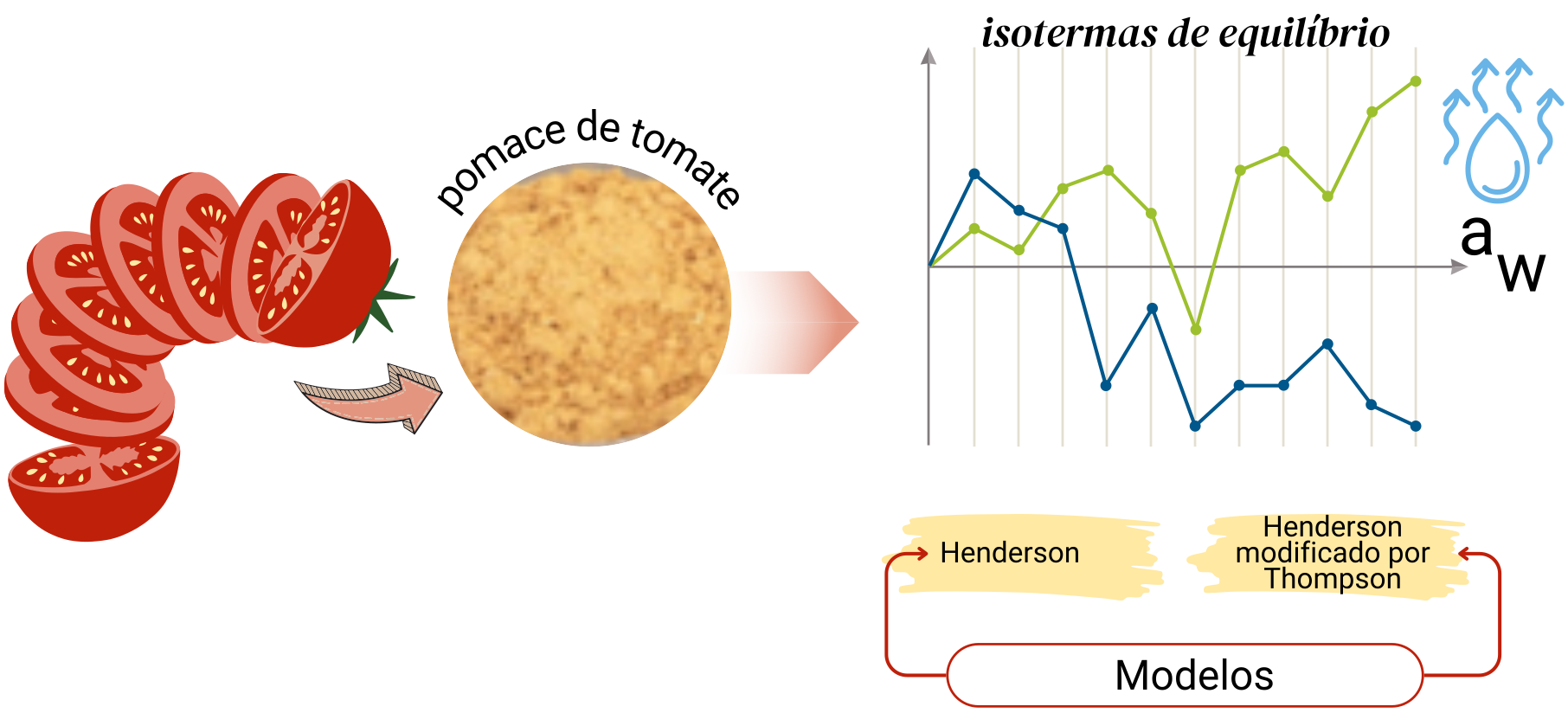
Brazil is one of the world’s largest tomato producers. During the industrialization process of this food, residues known as tomato pomace are generated and usually discarded. Tomato pomace, composed of skin, seeds, fibers, and remnants of tomato pulp, is a valuable by-product with potential for use in creating new products. This study aims to examine the equilibrium isotherm of dried tomato pomace at 95°C, using the mathematical models of Henderson and Henderson-Thompson for adsorption isotherms. Equilibrium moisture, theoretical moisture, and water activity were analyzed. Following the analyses and the study of the isotherm graph, the coefficients of determination found were 1 for the Henderson-Thompson model and 0.548 for the curve obtained with the experimental data. The results showed that the data followed a sigmoidal curve and that the Henderson-Thompson model fit the experimental data well. In contrast, the Henderson model did not provide plausible results, indicating that the data did not fit this model. Thus, tomato pomace has proven to be a promising by-product, with potential for application in new products, highlighting the importance of waste reuse in the food industry.
- Downloads
-
Download data is not yet available.
- References
-
Bracht, C. K., Menezes, M. L., Ambrosio-Ugri, M. C., & Pereira, N. C. (2014). Determinação das isotermas de equilíbrio das sementes de uva das variedades Cabernet Sauvignon e Bordô. Engevista, 17(1), 44. https://doi.org/10.22409/engevista.v17i1.558 DOI: https://doi.org/10.22409/engevista.v17i1.558
Cano-Chauca, M., Ramos, A. M., Stringheta, P. C., Marques, J. A., & Silva, P. I. (2004). Curvas de secagem e avaliação da atividade de água da banana passa. Boletim do Centro de Pesquisa de Processamento de Alimentos, 22(1). https://doi.org/10.5380/cep.v22i1.1184 DOI: https://doi.org/10.5380/cep.v22i1.1184
Cantarelli, P. R., Regitano-d’Arce, M. A. B., & Palma, E. R. (1993). Physicochemical characteristics and fatty acid composition of tomato seed oils from processing wastes. Scientia Agricola, 50(1), 117–120. https://doi.org/10.1590/s0103-90161993000100016 DOI: https://doi.org/10.1590/S0103-90161993000100016
Cardoso, F. F. 2012. Propriedades de adsorção de água em farinhas mistas de arroz e bagaço de cevada pré-gelatinizadas por extrusão termoplástica. 52 f. Dissertação (Mestrado) - Universidade Estadual de Goiás, Programa de Pós-Graduação em Engenharia Agrícola, Goiás.
Companhia Nacional de Abastecimento (CONAB). 2020. Tomate: análise dos indicadores da produção e comercialização no mercado mundial, brasileiro e catarinense. Compêndio de estudos Conab, v. 21, p. 11-12.
Ditchfield, C. 2000. Estudo dos métodos para medida da atividade de água. 195 f. Dissertação (Mestrado) - Escola Politécnica da Universidade de São Paulo, Pós-Graduação em Engenharia Química, São Paulo.
Ferreira, J. A., T.C. Andrade, M.C. Mancini, & Scheid, C. M. (2002). Obtenção do concentrado de feijão em pó em leito de jorro bidimensional. Revista Universidade Rural, Série Ciências Exatas e da Terra, 22(1), 105–112.
Fiorda, F. A. & Siqueira, M. I. D. de. 2009. Avaliação do pH e atividade de água em produtos cárneos. Revista Estudos - Revista de Ciências Ambientais e Saúde 36: 817–26. https://doi.org/10.18224/est.v36i4.1132
Fiorentin, L. D., Menon, B. T., Barros, S. T. D. de, Pereira, N. C., Lima, O. C. da M., & Modenes, A. N. (2010). Isotermas de sorção do resíduo agroindustrial bagaço de laranja. Revista Brasileira de Engenharia Agrícola e Ambiental, 14(6), 653–659. https://doi.org/10.1590/S1415-43662010000600012 DOI: https://doi.org/10.1590/S1415-43662010000600012
Furquim, M. G. D.; Nascimento, A. R. Aspectos relevantes para o entendimento da cadeia do tomate de mesa no Brasil. In: Estudos em Agronegócio: participação brasileira nas cadeias produtivas, v. 5, p. 173-196, 2021.
Henderson, M. S. (1952). A basic concept of equilibrium moisture. Agricultural Engineering, 33, 29–32. https://ci.nii.ac.jp/naid/10017619952
Iglesias, H.A.; & Chirife J. 1982. Handbook of food isotherms: water sorption parameters for food components. 1.ed. New York: Academic Press, 374 p. DOI: https://doi.org/10.1016/B978-0-12-370380-4.50006-2
Machado, C. F., Manterola, H., Porte, E., & Cerda, D. (1996). Study of ruminal pH, VFA and N-NH3 in Steers fed with increasing levels of tomato pomace. Avances En Producción Animal, 21(1–2), 105–113.
Orriss, G. D. (1997). Animal diseases of public health importance. Emerging Infectious Diseases, 3(4), 497–502. https://doi.org/10.3201/eid0304.970413 DOI: https://doi.org/10.3201/eid0304.970413
R Core Team. R: A language and environment for statistical computing. R Foundation for Statistical Computing, Vienna, 2023. Acesso em: 30 mar. 2023. Disponível em: <https://www.r-project.org>
Sampaio, R. M., Matos, E. N. V., & Paula, M. L. de. (2015). Determinação das isotermas de adsorção e do calor de sorção da farinha de babaçu comercial. Anais do XX Congresso Brasileiro de Engenharia Química, 5031–5037. https://doi.org/10.5151/chemeng-cobeq2014-1852-17210-137084 DOI: https://doi.org/10.5151/chemeng-cobeq2014-1852-17210-137084
Santos, J. C., Silva, G. F., Santos, J. A. B., & Oliveira Júnior, A. M. (2010). Processamento e avaliação da estabilidade da farinha de banana verde. Exacta, 8(2), 219–224. https://doi.org/10.5585/exacta.v8i2.2245 DOI: https://doi.org/10.5585/exacta.v8i2.2245
Thompson, T. L., Peart, R. M., & Foster, G. H. (1968). Mathematical simulation of corn drying - A new model. Transactions of the ASAE, 11(4), 0582–0586. https://doi.org/10.13031/2013.39473 DOI: https://doi.org/10.13031/2013.39473
- Cover Image
-
- Downloads
- Published
- 2024-07-02
- Issue
- Vol. 3 No. 1 (2024)
- Section
- Research Article
- License
-
Copyright (c) 2024 Brenda Velasco Borges, Ellen Carvalho Silva, Gilberto Alessandre Soares Goulart

This work is licensed under a Creative Commons Attribution 4.0 International License.
This journal publishes its Open Access articles under a Creative Commons license (CC BY 4.0).
You are free to:
Share — copy and redistribute the material in any medium or format for any purpose, even commercially.
Adapt — remix, transform, and build upon the material for any purpose, even commercially.
The licensor cannot revoke these freedoms as long as you follow the license terms.Under the following terms:
Attribution — You must give appropriate credit, provide a link to the license, and indicate if changes were made. You may do so in any reasonable manner, but not in any way that suggests the licensor endorses you or your use.No additional restrictions — You may not apply legal terms or technological measures that legally restrict others from doing anything the license permits.
Notices:
You do not have to comply with the license for elements of the material in the public domain or where your use is permitted by an applicable exception or limitation.No warranties are given. The license may not give you all of the permissions necessary for your intended use. For example, other rights such as publicity, privacy, or moral rights may limit how you use the material.

How to Cite




Similar Articles
- Beatriz de Aquino Marques da Costa, Ana Lúcia Figueiredo Porto, Vagne de Melo Oliveira, Tatiana Souza Porto, Bioactive collagen peptides: bibliometric approach and market trends for aquatic sources , Food Science Today: Vol. 2 No. 1 (2023)
- Rodrigo Zunta Raia, Functional potential of agro-industrial residue flours in yogurt and dairy beverage formulations: a literature review , Food Science Today: Vol. 3 No. 1 (2024)
- Rafael Fernandes Almeida, Patrícia de Magalhães Prado, Camila Filgueira de Souza, Vanessa Regina Kunz, Bruna Peregrino de Souza, Claudia Elizabeth da Silva Moraes, Elizangela Gonçalves de Oliveira, Low-cost solar dryer dehydrates silver banana with a prediction of diffusion approximation model , Food Science Today: Vol. 3 No. 1 (2024)
- Silmara Batista de Oliveira, Renata Baraldi de Pauli Bastos, Lea Rita Pestana Ferreira Mello Ivano , The impact of the new Brazilian labeling standard, RDC 429/2020, on access to food nutrition information: A review , Food Science Today: Vol. 2 No. 1 (2023)
- Gerson Lopes Teixeira, Bruno Luís Ferreira, The impact of Brazilian food science over the past two decades. A critical review and meta-analysis , Food Science Today: Vol. 1 No. 1 (2023)
- Luis Alberto Mendoza-Flores, Jesús Guadalupe Pérez-Flores, Laura García-Curiel, Alma Elizabeth Cruz-Guerrero, Emmanuel Pérez-Escalante, Elizabeth Contreras-López, Luis Guillermo González-Olivares, Whey as a functional ingredient in the food industry: a bibliometric study on its potential and innovation , Food Science Today: Vol. 4 No. 1 (2025)
- Yair Noé Ávila-Vargas, Laura García-Curiel, Jesús Guadalupe Pérez-Flores, Gabriela Mariana Rodríguez-Serrano, Elizabeth Contreras-López, Luis Guillermo González-Olivares, Rita Paz-Samaniego, Emmanuel Pérez-Escalante, Bioactive peptide generation using flavourzyme: functional potentials and emerging applications , Food Science Today: Vol. 4 No. 1 (2025)
- Daniele Cobus, Graziela Nunes, Luane de Oliveira Maior, Luiz Gustavo Lacerda, Vivian Cristina Ito, Unconventional Food Plants (UFPs): an approach to the nutritional and functional properties of nasturtium (Tropaeolum majus L.) , Food Science Today: Vol. 1 No. 1 (2023)
- Helayne Aparecida Maieves, Bruna Vaz da Silva, Marielly Ewerling, Ugo Ribeiro Comparotto, Francielly Becker Lessa, Amábile Nunes Lemos, Júlia Porto Hepp, The behavior of lemon-based thickened fluids submitted to the IDDSI flow test as a strategy for dysphagia treatment , Food Science Today: Vol. 1 No. 1 (2023)
- Alessandra Ramos de Jesus Minas, Davi Lobo Lins de Sousa, Ronieri Francilino de Lima, Erlânio Oliveira de Sousa, Maria Karine de Sá Barreto Feitosa, Naíza Maria Galdino Cruz, Physicochemical and nutritional characterization of Maranhão nut (Pachira aquatica Aubl.) flour from Crato - CE , Food Science Today: Vol. 4 No. 1 (2025)
You may also start an advanced similarity search for this article.