
Impact of different cooking methods on the proximate chemical and fatty acid composition of blackspot seabream (Pagellus bogaraveo) and blackbelly rosefish (Helicolenus dactylopterus) from the North Atlantic Azores (Portugal) Archipelago
- Authors
-
-
Joana Filipa Furtado Goulart
-
Alexandre Correia Pereira
-
Ana Sofia Ribeiro de Oliveira
-
António Manuel Barros Marques
-
Inês do Carmo Alves Martins
-
- Keywords:
- Demersal fish, Cooking methods, Nutritional quality, Fatty acid composition, Fish quality, Azores archipelago, Consumers health
- Abstract
-
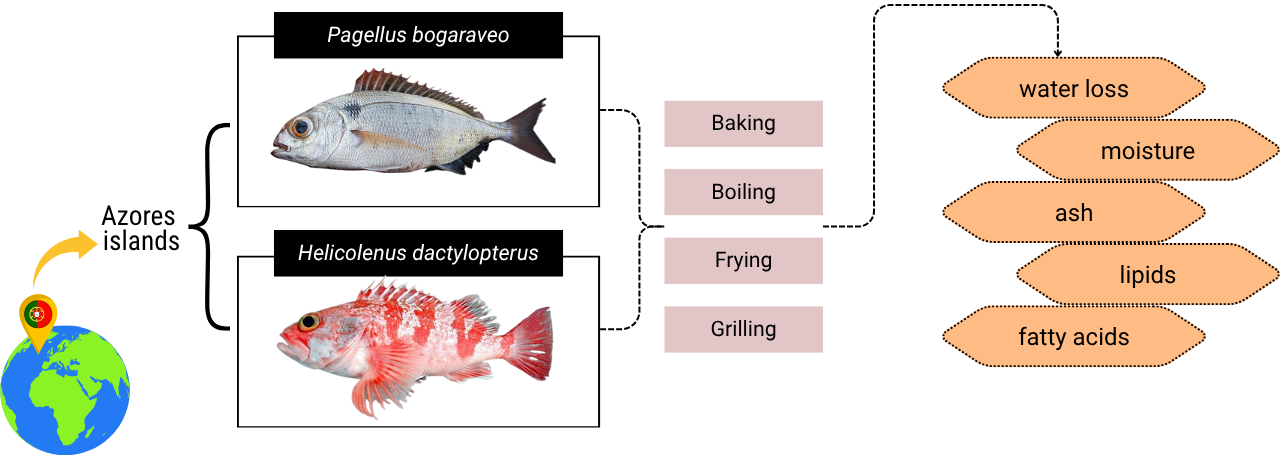
Demersal fish are essential to the gastronomy and economy of the Azores (Portugal), highlighting the importance of preserving their nutritional quality, which requires further research regarding the suitability of the cooking methods applied. The aim of this study was to evaluate the proximate composition and fatty acid profile of blackspot seabream (Pagellus bogaraveo) and blackbelly rosefish (Helicolenus dactylopterus) following different cooking methods (baking, boiling, frying and grilling) in order to conclude which is most suitable for preserving the nutritional quality of each species. Parameters such as water loss (calculation), moisture and ash (thermogravimetry), total fat (acid hydrolysis with extraction process) and fatty acid profile (gas chromatography with flame ionization detection) were analyzed. One-way analysis of variance (ANOVA) was conducted to compare sample means and identify significant differences between species. The obtained results indicated that grilling retained the highest mineral content, while all cooking methods resulted in unsaturated fatty acids/saturated fatty acids ratios above recommended values, confirming the high nutritional quality of both species. Based on polyunsaturated fatty acids composition and lipid health indices (fresh-lipid quality, atherogenicity index, thrombogenicity index, health-promoting index, polyene index, and hypocholesterolemic/hypercholesterolemic ratio), grilling was the most suitable method for blackspot seabream (Pagellus bogaraveo), whereas boiling was optimal for blackbelly rosefish (Helicolenus dactylopterus). These findings highlight the impact of cooking methods on these fish species nutritional value, reinforcing their role in promoting cardiovascular health.
- Downloads
-
Download data is not yet available.
- References
-
Abrami, G., Natiello, F., Bronzi, P., McKenzie, D., Bolis, L., & Agradi, E. (1992). A comparison of highly unsaturated fatty acid levels in wild and farmed eels (Anguilla anguilla). Comparative Biochemistry and Physiology. B, Comparative Biochemistry, 101(1-2), 79-81.https://doi.org/10.1016/0305-0491(92)90161-J
Ahmed, I., Jan, K., Fatma, S., & Dawood, M. A. O. (2022). Muscle proximate composition of various food fish species and their nutritional significance: A review. Journal of Animal Physiology and Animal Nutrition, 106(3), 690–719. https://doi.org/10.1111/jpn.13711
An, F., Kang, X., Zhang, L., Leilei, JinbaoWang, Shao, B., & Wang, J. (2013). Comparison of muscle properties and meat quality between Jing Ning chicken and Ling Nan Huang Yu meat chicken . Journal of Food, Agriculture and Environment, 11(1), 54–58. https://doi.org/https://doi.org/10.1234/4.2013.3768
Asghari, L., Zeynali, F., & Sahari, M. A. (2013). Effects of boiling, deep-frying, and microwave treatment on the proximate composition of rainbow trout fillets: changes in fatty acids, total protein, and minerals. Journal of Applied Ichthyology, 29(4), 847–853. https://doi.org/10.1111/jai.12212
Barua, P., Pervez, M. A., Sarkar, D., & Sarker, S. (2022). Proximate biochemical composition of some commercial marine fishes from Bay of Bengal, Bangladesh. Mesopotamian Journal of Marine Sciences, 27(1), 59–66. https://doi.org/10.58629/mjms.v27i1.172
Begum, M., Bhowmik, S., Juliana, F. M., & Hossain, M. S. (2016). Nutritional profile of hilsa fish [Tenualosa ilisha (Hamilton, 1822)] in six selected regions of Bangladesh. Journal of Nutrition & Food Sciences, 06(06). https://doi.org/10.4172/2155-9600.1000567
Bentes, Á. de S., Souza, H. A. L. de, Simões, M. G., & Mendonça, X. M. F. D. (2009). Caracterização física e química e perfil lipídico de três espécies de peixes amazônicos. Revista Brasileira de Tecnologia Agroindustrial, 3(2). https://doi.org/10.3895/S1981-36862009000200011
Berber, S., Acarlı, S., Bayraklı, B., Kale, S., Kızılkaya, B., Vural, P., & Acarlı, D. (2024). Monthly variation of fatty acids, lipid quality index and metal content of Pontastacus leptodactylus (Eschscholtz, 1823) in Atikhisar Dam Lake (Çanakkale, Türkiye). Environmental Science and Pollution Research, 31(18), 27014–27036. https://doi.org/10.1007/s11356-024-32858-1
Chen, S., Bobe, G., Zimmerman, S., Hammond, E. G., Luhman, C. M., Boylston, T. D. & Beitz, D. C. (2004). Physical and sensory properties of dairy products from cows with various milk fatty acid compositions. Journal of Agricultural and Food Chemistry, 52(11), 3422-3428. https://doi.org/10.1021/jf035193z
Costa, E. F. S., Menezes, G. M., & Colaço, A. (2024). Trait-based insights into sustainable fisheries: A four-decade perspective in Azores archipelago. Science of The Total Environment, 935, 173271. https://doi.org/10.1016/j.scitotenv.2024.173271
Domiszewski, Z., Bienkiewicz, G., Plust, D., & Kulasa, M. (2011). Quality of lipids in marinated herring. Electronic Journal of Polish Agricultural Universities, 14(1). http://www.ejpau.media.pl/volume14/issue1/art-09.html
Duarte, A. M., Silva, F., Mendes, S., Pinto, F. R., Barroso, S., Silva, E., Neves, A., Sequeira, V., Magalhães, M. F., Rebelo, R., Assis, C., Vieira, A. R., Gordo, L. S., & Gil, M. M. (2022). Seasonal study of the nutritional composition of unexploited and low commercial value fish species from the Portuguese coast. Food Science & Nutrition, 10(10), 3368–3379. https://doi.org/10.1002/fsn3.2937
Duyar, H. A., & Bayrakli, B. (2023). Fatty acid profiles of fish oil derived by different techniques from by-products of cultured black sea salmon, Oncorhynchus mykiss. Journal of Agricultural Sciences, 29(3), 833–841. https://doi.org/10.15832/ankutbd.1187017
Fernandes, C. E., Vasconcelos, M. A. da S., Ribeiro, M. de A., Sarubbo, L. A., Andrade, S. A. C., & Melo Filho, A. B. de. (2014). Nutritional and lipid profiles in marine fish species from Brazil. Food Chemistry, 160, 67–71. https://doi.org/10.1016/j.foodchem.2014.03.055
Fernández-Palacios, Y., Kaushik, S., Abramic, A., Cordero-Penín, V., García-Mendoza, A., Bilbao-Sieyro, A., Pérez-González, Y., Sepúlveda, P., Lopes, I., Andrade, C., Nogueira, N., Carreira, G. P., Magalhães, M., & Haroun, R. (2023). Status and perspectives of blue economy sectors across the Macaronesian archipelagos. Journal of Coastal Conservation, 27(5), 39. https://doi.org/10.1007/s11852-023-00961-z
Garcı́a-Arias, M. T., Álvarez Pontes, E., Garcı́a-Linares, M. C., Garcı́a-Fernández, M. C., & Sánchez-Muniz, F. J. (2003). Cooking–freezing–reheating (CFR) of sardine (Sardina pilchardus) fillets. Effect of different cooking and reheating procedures on the proximate and fatty acid compositions. Food Chemistry, 83(3), 349–356. https://doi.org/10.1016/S0308-8146(03)00095-5
Huynh, M. D., & Kitts, D. D. (2009). Evaluating nutritional quality of pacific fish species from fatty acid signatures. Food Chemistry, 114(3), 912–918. https://doi.org/10.1016/j.foodchem.2008.10.038
International Organization for Standardization. (2012). Animal feeding stuffs - Guidelines for sample preparation: reference method. In ISO 6498:2012.
Tilami, S. K., & Sampels, S. (2018). Nutritional value of fish: Lipids, proteins, vitamins, and minerals. Reviews in Fisheries Science & Aquaculture, 26(2), 243–253. https://doi.org/10.1080/23308249.2017.1399104
Khan, I., Hussain, M., Jiang, B., Zheng, L., Pan, Y., Hu, J., Khan, A., Ashraf, A., & Zou, X. (2023). Omega-3 long-chain polyunsaturated fatty acids: Metabolism and health implications. Progress in Lipid Research, 92, 101255. https://doi.org/10.1016/j.plipres.2023.101255
Larsen, D., Quek, S. Y., & Eyres, L. (2010). Effect of cooking method on the fatty acid profile of New Zealand King Salmon (Oncorhynchus tshawytscha). Food Chemistry, 119(2), 785–790. https://doi.org/10.1016/j.foodchem.2009.07.037
Lubis, Z., & Buckle, K. A. (1990). Rancidity and lipid oxidation of dried‐salted sardines. International Journal of Food Science & Technology, 25(3), 295–303. https://doi.org/10.1111/j.1365-2621.1990.tb01085.x
Marques, I., Botelho, G., & Guiné, R. (2019). Comparative study on nutritional composition of fish available in Portugal. Nutrition & Food Science, 49(5), 925–941. https://doi.org/10.1108/NFS-11-2018-0311
Maulvault, A. L., Anacleto, P., Lourenço, H. M., Carvalho, M. L., Nunes, M. L., & Marques, A. (2012). Nutritional quality and safety of cooked edible crab (Cancer pagurus). Food Chemistry, 133(2), 277–283. https://doi.org/10.1016/j.foodchem.2012.01.023
Méndez, E., & González, R. M. (1997). Seasonal changes in the chemical and lipid composition of fillets of the Southwest Atlantic hake (Merluccius hubbsi). Food Chemistry, 59(2), 213–217. https://doi.org/10.1016/S0308-8146(96)00225-7
Mieiro, C. L., Coelho, J. P., Dolbeth, M., Pacheco, M., Duarte, A. C., Pardal, M. A., & Pereira, M. E. (2016). Fish and mercury: Influence of fish fillet culinary practices on human risk. Food Control, 60, 575–581. https://doi.org/10.1016/j.foodcont.2015.09.006
Nogueira, N., Cordeiro, N., & Aveiro, M. J. (2013). Chemical composition, fatty acids profile and cholesterol content of commercialized marine fishes captured in Northeastern Atlantic. Journal of FisheriesSciences.Com, 7(3), 271–286. https://doi.org/10.3153/jfscom.2013029
Norma Portuguesa. (2000). NP EN ISO 872:2000. Qualidade da água - Determinação dos sólidos em suspensão - Método por filtração com filtros de fibra de vidro. Instituto Português Da Qualidade.
Norma Portuguesa. (2002). NP 1615:2002. Carne e produtos cárneos: determinação da cinza total: Método de Referência. Instituto Português Da Qualidade.
Norma Portuguesa. (2009). NP 1614-1:2009. Carne e produtos cárneos: determinação do teor de humidade – Parte 1: Método de Referência. Instituto Português Da Qualidade.
Norma Portuguesa. (2014). NP ISO 6492-2014. Alimentos para animais. Determinação do teor de gordura. Instituto Português Da Qualidade.
Pereira, I., Peixoto, U. I., Medeiros-Leal, W., Casal-Ribeiro, M., & Santos, R. (2022). Multidimensional Indicators to Assess the Sustainability of Demersal Small-Scale Fishery in the Azores. Sustainability, 14(24), 16585. https://doi.org/10.3390/su142416585
Pipoyan, D., Stepanyan, S., Stepanyan, S., Beglaryan, M., Costantini, L., Molinari, R., & Merendino, N. (2021). The effect of trans fatty acids on human health: Regulation and consumption patterns. Foods, 10(10), 2452. https://doi.org/10.3390/foods10102452
Ryu, B., Shin, K.-H., & Kim, S.-K. (2021). Muscle protein hydrolysates and amino acid composition in fish. Marine Drugs, 19(7), 377. https://doi.org/10.3390/md19070377
Saldanha, T., & Bragagnolo, N. (2010). Effects of grilling on cholesterol oxide formation and fatty acids alterations in fish. Ciência e Tecnologia de Alimentos, 30(2), 385–390. https://doi.org/10.1590/S0101-20612010000200015
Santos, R. V. S., Silva, W. M. M. L., Novoa-Pabon, A. M., Silva, H. M., & Pinho, M. R. (2019). Long-term changes in the diversity, abundance and size composition of deep sea demersal teleosts from the Azores assessed through surveys and commercial landings. Aquatic Living Resources, 32, 25. https://doi.org/10.1051/alr/2019022
Sioen, I., Haak, L., Raes, K., Hermans, C., De Henauw, S., De Smet, S., & Van Camp, J. (2006). Effects of pan-frying in margarine and olive oil on the fatty acid composition of cod and salmon. Food Chemistry, 98(4), 609–617. https://doi.org/10.1016/j.foodchem.2005.06.026
Song, J., Kim, Y.-S., Lee, D. H., Lee, S. H., Park, H. J., Lee, D., & Kim, H. (2019). Neuroprotective effects of oleic acid in rodent models of cerebral ischaemia. Scientific Reports, 9(1), 10732. https://doi.org/10.1038/s41598-019-47057-z
Tan, K., Huang, L., Tan, K., Lim, L., Peng, Y., & Cheong, K.-L. (2023). Effects of culinary treatments on the lipid nutritional quality of fish and shellfish. Food Chemistry: X, 19, 100856. https://doi.org/10.1016/j.fochx.2023.100856
Teixeira, A., Fernandes, A., & Pereira, E. (2020). Fat content reduction and lipid profile improvement in Portuguese fermented sausages alheira. Heliyon, 6(10), e05306. https://doi.org/10.1016/j.heliyon.2020.e05306
Torres, P., Milla i Figueras, D., Diogo, H., & Afonso, P. (2022). Risk assessment of coastal fisheries in the Azores (north-eastern Atlantic). Fisheries Research, 246, 106156. https://doi.org/10.1016/j.fishres.2021.106156
Ulbricht, T. L. V., & Southgate, D. A. T. (1991). Coronary heart disease: seven dietary factors. The Lancet, 338(8773), 985–992. https://doi.org/10.1016/0140-6736(91)91846-M
Uran, H., & Gokoglu, N. (2014). Effects of cooking methods and temperatures on nutritional and quality characteristics of anchovy (Engraulis encrasicholus). Journal of Food Science and Technology, 51(4), 722–728. https://doi.org/10.1007/s13197-011-0551-5
Valério, N., Soares, M., Vilarinho, C., Correia, M., & Carvalho, J. (2023). Diving into Fish Valorisation: Review Opportunities and Analyzing Azorean Fish Data. Processes, 11(7), 1998. https://doi.org/10.3390/pr11071998
Weber, J., Bochi, V. C., Ribeiro, C. P., Victório, A. de M., & Emanuelli, T. (2008). Effect of different cooking methods on the oxidation, proximate and fatty acid composition of silver catfish (Rhamdia quelen) fillets. Food Chemistry, 106(1), 140–146. https://doi.org/10.1016/j.foodchem.2007.05.052
WHO. (2002). Population nutrient intake goals for preventing diet-related chronic diseases. In Diet, nutrition and the prevention of chronic diseases: report of a joint WHO/FAO expert consultation (pp. 54–59). WHO/FAO.
- Cover Image
-
- Downloads
- Additional Files
- Published
- 2025-10-07
- Issue
- Vol. 4 No. 1 (2025)
- Section
- Research Article
- License
-
Copyright (c) 2025 Joana Filipa Furtado Goulart, Alexandre Correia Pereira, Ana Sofia Ribeiro de Oliveira, António Manuel Barros Marques , Inês do Carmo Alves Martins

This work is licensed under a Creative Commons Attribution 4.0 International License.
This journal publishes its Open Access articles under a Creative Commons license (CC BY 4.0).
You are free to:
Share — copy and redistribute the material in any medium or format for any purpose, even commercially.
Adapt — remix, transform, and build upon the material for any purpose, even commercially.
The licensor cannot revoke these freedoms as long as you follow the license terms.Under the following terms:
Attribution — You must give appropriate credit, provide a link to the license, and indicate if changes were made. You may do so in any reasonable manner, but not in any way that suggests the licensor endorses you or your use.No additional restrictions — You may not apply legal terms or technological measures that legally restrict others from doing anything the license permits.
Notices:
You do not have to comply with the license for elements of the material in the public domain or where your use is permitted by an applicable exception or limitation.No warranties are given. The license may not give you all of the permissions necessary for your intended use. For example, other rights such as publicity, privacy, or moral rights may limit how you use the material.

How to Cite




Similar Articles
- Francisca Vanessa Maia Pinto, Cleidiane Gomes Lima, Lia Mariano Aquino, Jéssica Roberta Pereira Martins, Séfura Maria Assis Moura, Luana Guabiraba Mendes, Julliete Raulino Alcântara, Yago Queiroz dos Santos, Maria Aparecida Liberato Milhome, Lipid quality associated with the fatty acid profile of fruit yogurts , Food Science Today: Vol. 5 No. 1 (2026)
- Silmara Batista de Oliveira, Renata Baraldi de Pauli Bastos, Lea Rita Pestana Ferreira Mello Ivano , The impact of the new Brazilian labeling standard, RDC 429/2020, on access to food nutrition information: A review , Food Science Today: Vol. 2 No. 1 (2023)
- Gabriela Dremiski, Amanda da Silva Hoffmann, Vivian Cristina Ito, Food and Nutritional Education: healthy eating and combating childhood iron deficiency anemia in poor communities assisted by Pastoral Care for Children , Food Science Today: Vol. 4 No. 1 (2025)
- Anelisa Doretto Freitas Furlan, Marta Cristina Uga Ferreira, Caline Nogueira Inácio dos Santos, Nutritional composition of gluten-free rice flour cookies enriched with eggshell powder as an alternative for celiacs , Food Science Today: Vol. 3 No. 1 (2024)
- Rosimery Rodrigues de Oliveira, Thalita de Oliveira dos Santos, Iscarllety Richelly de Aguiar da Silva, Macroscopic and microscopic evaluation of bulk annatto (Bixa orellana) sold in the city of Teresina, PI , Food Science Today: Vol. 3 No. 1 (2024)
- Zaira Daniela Solís-Macías, Jesús Guadalupe Pérez-Flores , Laura García-Curiel , Luis Guillermo González-Olivares , Gabriela Mariana Rodríguez-Serrano, Elizabeth Contreras-López , Alexis Ayala-Niño , Emmanuel Pérez-Escalante, Lactic acid bacteria in wheat fermentation: A bibliometric analysis of antioxidant peptide production , Food Science Today: Vol. 4 No. 1 (2025)
- Lyara Bruna Soares Nascimento, Clara Rodrigues de Almeida Sousa, Débora Wanzeler Levino, Laisianne Alves Ferreira, Lucas Araújo de Queiroz, Ranne Beatriz Santana de Lima, Karlete Vânia Mendes Vieira, Beer production and importance of Saccharomyces cerevisiae , Food Science Today: Vol. 4 No. 1 (2025)
- Aline Tiecher Marin, Emanoelly Cristiny Prates Fronza, Liliane dos Santos, Silmara Pastre, Albimara Hey, Ricardo Aparecido Pereira, Evaluation of physicochemical parameters and phenolic compounds of craft beer subjected to forced aging , Food Science Today: Vol. 2 No. 1 (2023)
- Armando Mateus Moiana, Chaid Acácio António Mussalafo, Jausse Elias Camunacossa, Inocêncio Collor de Melo Horácio, Development of flour based on breadfruit (Artocarpus altilis) enriched with cassava starch (Manihot esculenta) and roasted peanut flour (Arachis hypogaea L) , Food Science Today: Vol. 5 No. 1 (2026)
- Rodrigo Zunta Raia, Functional potential of agro-industrial residue flours in yogurt and dairy beverage formulations: a literature review , Food Science Today: Vol. 3 No. 1 (2024)
You may also start an advanced similarity search for this article.