
Development and nutritional characterization of chips made with tucumã-do-Amazonas flour (Astrocaryum aculeatum): a healthy and sustainable alternative for food consumption
- Authors
-
-
- Keywords:
- Functional foods, Sustainable development, Amazonian fruits, β-Carotene, Nutritional characterization, Alternative food products
- Abstract
-
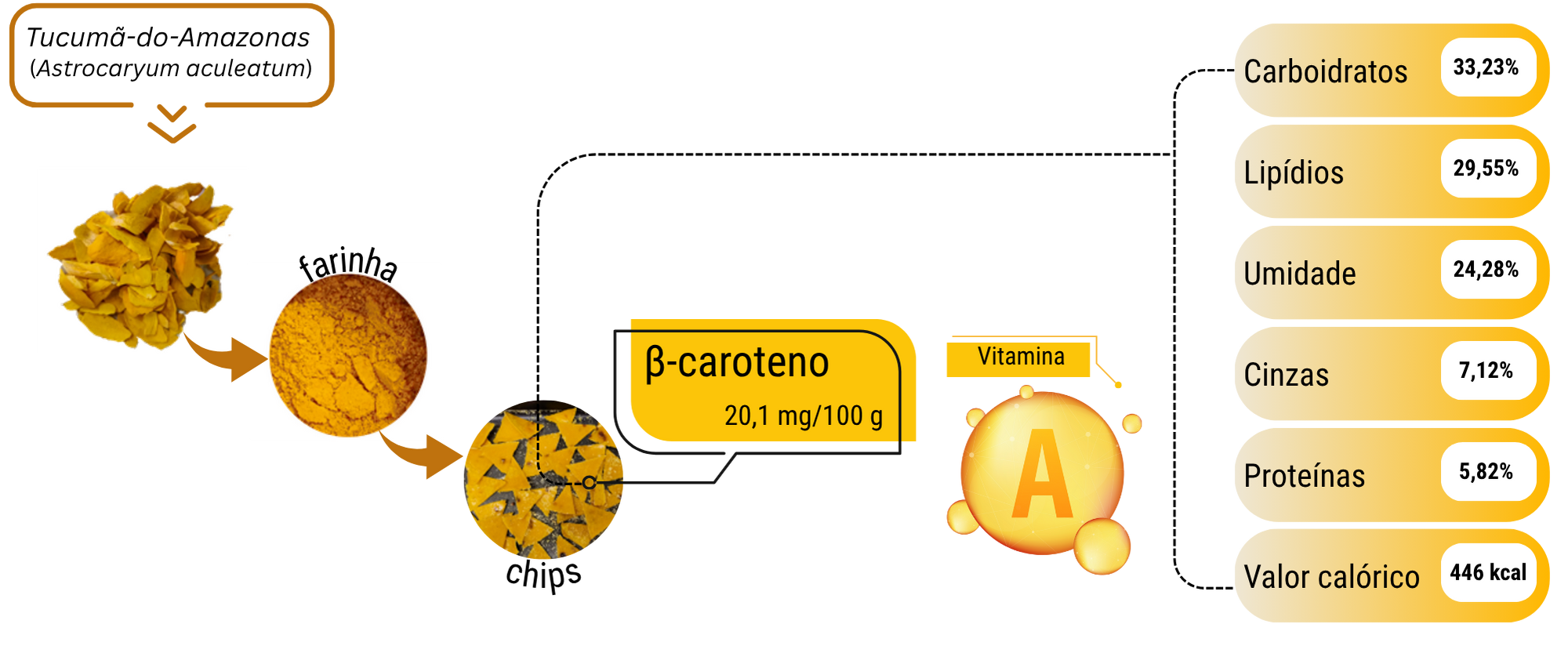
The fruit of Astrocaryum aculeatum, native to the Amazon, possesses high nutritional value and functional potential but remains underutilized in food product development. This study aimed to develop and nutritionally characterize chips made from A. aculeatum flour as a healthy and sustainable food alternative. The formulation involved mixing the flour with water, salt, and dehydrated seasonings, followed by oven drying to achieve a crispy texture. Proximate composition, pH, and β-carotene content were analyzed, with β-carotene quantified using high-performance liquid chromatography (HPLC). The chips contained 33.23% carbohydrates, 29.55% lipids, 24.28% moisture, 7.12% ash, 5.82% protein, and an energy value of 446 kcal. The slightly acidic pH (5.66) favors product preservation, and the high β-carotene content (20.1 mg/100 g) highlights the chips as an excellent source of vitamin A. These results highlight the potential of A. aculeatum chips as a functional food, promoting the sustainable use of Amazonian biodiversity and contributing to food security.
- Downloads
-
Download data is not yet available.
- References
-
Amorim, I. S., Amorim, D. S., Godoy, H. T., Mariutti, L. R. B., Chisté, R. C., Pena, R. da S., Bogusz Junior, S., & Chim, J. F. (2024). Amazonian palm tree fruits: From nutritional value to diversity of new food products. Heliyon, 10(2), e24054. https://doi.org/10.1016/j.heliyon.2024.e24054 DOI: https://doi.org/10.1016/j.heliyon.2024.e24054
Assis, R. Q., Maciel, F. S., Queiroz, B. B. T., Rios, A. de O., & Pertuzatti, P. B. (2025). Active films incorporated with pequi (Caryocar brasiliense Camb.) or buriti (Mauritia flexuosa L.) oil as strategy to protection of lipid oxidation and carotenoids photodegradation. Food Chemistry, 482, 144085. https://doi.org/10.1016/j.foodchem.2025.144085 DOI: https://doi.org/10.1016/j.foodchem.2025.144085
Azevedo, S. C. M., Vieira, L. M., Matsuura, T., Silva, G. F. da, Duvoisin Junior, S., & Albuquerque, P. M. (2017). Estudo da conservação das propriedades nutricionais da polpa de tucumã (Astrocaryum aculeatum) in natura em embalagens a vácuo. Brazilian Journal of Food Technology, 20(0). https://doi.org/10.1590/1981-6723.10716 DOI: https://doi.org/10.1590/1981-6723.10716
Batista, D. de V. S., Cardoso, R. L., Godoy, R. C. B. de, & Evangelista-Barreto, N. S. (2014). Estabilidade físico-química e microbiológica de banana passa orgânica. Ciência Rural, 44(10), 1886–1892. https://doi.org/10.1590/0103-8478cr20130442 DOI: https://doi.org/10.1590/0103-8478cr20130442
Casas, L. L., Jesus, R. P. de, Neto, P. de Q. C., & Corrêa, S. A. M. (2022). Aspectos nutricionais, químicos e farmacológicos de Tucumã (Astrocaryum aculeatum Meyer e Astrocaryum vulgare Mart.) Nutritional, chemical and pharmacological aspects of Tucumã (Astrocaryum aculeatum Meyer and Astrocaryum vulgare Mart.). Brazilian Journal of Development, 8(2), 13667–13687. https://doi.org/10.34117/bjdv8n2-344 DOI: https://doi.org/10.34117/bjdv8n2-344
Coutinho, L. S., Batista, J. E. R., Caliari, M., & Soares Júnior, M. S. (2013). Optimization of extrusion variables for the production of snacks from by-products of rice and soybean. Food Science and Technology (Campinas), 33(4), 705–712. https://doi.org/10.1590/S0101-20612013000400016 DOI: https://doi.org/10.1590/S0101-20612013000400016
De Rosso, V. V., & Mercadante, A. Z. (2005). Carotenoid composition of two Brazilian genotypes of acerola (Malpighia punicifolia L.) from two harvests. Food Research International, 38(8–9), 1073–1077. https://doi.org/10.1016/j.foodres.2005.02.023 DOI: https://doi.org/10.1016/j.foodres.2005.02.023
Ferreira, M. J. A., Mota, M. F. S., Mariano, R. G. B., & Freitas, S. P. (2022). Current scenario and recent advancements from tucumã pulp oil and kernel fat processing. European Journal of Lipid Science and Technology, 124(12). https://doi.org/10.1002/ejlt.202100231 DOI: https://doi.org/10.1002/ejlt.202100231
Grizotto, R. K., & Menezes, H. C. de. (2004). Efeito da fermentação na qualidade de “chips” de mandioca (Manihot esculenta Crantz). Ciência e Tecnologia de Alimentos, 24(2), 170–177. https://doi.org/10.1590/S0101-20612004000200003 DOI: https://doi.org/10.1590/S0101-20612004000200003
Gul, K., Tak, A., Singh, A. K., Singh, P., Yousuf, B., & Wani, A. A. (2015). Chemistry, encapsulation, and health benefits of β-carotene - A review. Cogent Food & Agriculture, 1(1), 1018696. https://doi.org/10.1080/23311932.2015.1018696 DOI: https://doi.org/10.1080/23311932.2015.1018696
Gurak, P. D. (2011). Degradação térmica e química de beta-caroteno e sua relação com a capacidade antioxidante e propriedades de cor. Tese (doutorado). Faculdade de Engenharia de Alimentos. Universidade Estadual de Campinas. https://doi.org/10.47749/T/UNICAMP.2011.836958 DOI: https://doi.org/10.47749/T/UNICAMP.2011.836958
Horwitz, W., & Latimer, G. W. (2005). Official methods of analysis of AOAC International (18th ed.). AOAC International.
Kaur, M., Sumaya, & Kalidhasan, M. (2024). Food, Snacks, and Beverages: Business Management Perspectives. Em Reference Module in Social Sciences. Elsevier. https://doi.org/10.1016/B978-0-443-13701-3.00523-5 DOI: https://doi.org/10.1016/B978-0-443-13701-3.00523-5
Ma, C., Li, C., Tian, H., Zhang, Q., Daizhu Lv, & Wang, M. (2025). Behavior of commonly used pesticides and their metabolites in banana fruits from cultivation, storage, maturation to crisp chips processing and health risk assessment. Journal of Food Composition and Analysis, 107550–107550. https://doi.org/10.1016/j.jfca.2025.107550 DOI: https://doi.org/10.1016/j.jfca.2025.107550
Machado, A. P. da F., Nascimento, R. de P. do, Alves, M. da R., Reguengo, L. M., & Marostica Junior, M. R. (2022). Brazilian tucumã-do-Amazonas (Astrocaryum aculeatum) and tucumã-do-Pará (Astrocaryum vulgare) fruits: bioactive composition, health benefits, and technological potential. Food Research International, 151, 110902. https://doi.org/10.1016/j.foodres.2021.110902 DOI: https://doi.org/10.1016/j.foodres.2021.110902
Maetens, E., Hettiarachchy, N., Dewettinck, K., Horax, R., Moens, K., & Moseley, D. O. (2017). Physicochemical and nutritional properties of a healthy snack chip developed from germinated soybeans. LWT, 84, 505–510. https://doi.org/10.1016/j.lwt.2017.06.020 DOI: https://doi.org/10.1016/j.lwt.2017.06.020
Manzocco, L., Calligaris, S., & Nicoli, M. C. (2010). Methods for food shelf life determination and prediction. Em Oxidation in Foods and Beverages and Antioxidant Applications (p. 196–222). Elsevier. https://doi.org/10.1533/9780857090447.1.196 DOI: https://doi.org/10.1533/9780857090447.1.196
Martínez-Girón, J., Cafarella, C., Rigano, F., Giuffrida, D., Mondello, L., Baena, Y., Osorio, C., & Ordóñez-Santos, L. E. (2024). Peach palm fruit (Bactris gasipaes ) peel: A source of provitamin A carotenoids to develop emulsion-based delivery systems. ACS Omega, 9(26), 28738–28753. https://doi.org/10.1021/acsomega.4c03095 DOI: https://doi.org/10.1021/acsomega.4c03095
Mota, M. F. dos S., Santos, R. R., Rocha, V. A. L., Braga, D. T., Gomez, J. G. C., Freitas, S. P., Cortes, M. V. de C. B., Freitas Silva, O., Perrone, D., Cavalcanti, E. d’Avila C., & Guimarães Freire, D. M. (2024). Extraction of phenolic compounds from tucuma (Astrocaryum vulgare Mat.) postprocessing cake mediated by rhamnolipids: Evaluation of its antifungal potential against common fruit pathogens. ACS Food Science & Technology, 4(10), 2430–2438. https://doi.org/10.1021/acsfoodscitech.4c00563 DOI: https://doi.org/10.1021/acsfoodscitech.4c00563
Rodriguez-Amaya, D. B. (2001). A guide to carotenoid analysis in foods (Vol. 71). Washington, DC, USA:: ILSI press. https://citeseerx.ist.psu.edu/document?repid=rep1&type=pdf&doi=a70fa5a74e79a526d8ea898d193da3588a09a9b6
Rodriguez-Amaya, Delia B., Kimura, M. 2004. HarvestPlus handbook for carotenoid analysis. HarvestPlus Technical Monographs. 2. https://hdl.handle.net/10568/157384
Sagrillo, M. R., Garcia, L. F. M., de Souza Filho, O. C., Duarte, M. M. M. F., Ribeiro, E. E., Cadoná, F. C., & da Cruz, I. B. M. (2015). Tucumã fruit extracts (Astrocaryum aculeatum Meyer) decrease cytotoxic effects of hydrogen peroxide on human lymphocytes. Food Chemistry, 173, 741–748. https://doi.org/10.1016/j.foodchem.2014.10.067 DOI: https://doi.org/10.1016/j.foodchem.2014.10.067
Santos, M. M. R., Fernandes, D. S., Cândido, C. J., Cavalheiro, L. F., Silva, A. F. da, Nascimento, V. A. do, Ramos Filho, M. M., Santos, E. F. dos, & Hiane, P. A. (2018). Physical-chemical, nutritional and antioxidant properties of tucumã (Astrocaryum huaimi Mart.) fruits. Semina: Ciências Agrárias, 39(4), 1517. https://doi.org/10.5433/1679-0359.2018v39n4p1517 DOI: https://doi.org/10.5433/1679-0359.2018v39n4p1517
SIBBr. (2018). Sistema de Informação sobre a Biodiversidade Brasileira. Tucumã, fruto, polpa, sem casca, sem semente, cru [Base de dados]. https://ferramentas.sibbr.gov.br/ficha/bin/view/FN/ShortName/3625_tucuma_fruto_polpa_sem_casca_sem_semente_crua
Sousa, M. L. R. de, Albuquerque, I. R. de, Moura, L. P. R., Rocha, B. S. da, Nogueira, J. da C., & Freitas, A. D. G. de. (2023). Potencial antimicrobiano dos extratos metanólicos das plantas Astrocaryum aculeatum (tucumã) e Turnera subulata (flor do Guarujá) frente a isolados de bactérias patogênicas. Revista Valore, 8. https://doi.org/10.22408/reva8020231013e-8065 DOI: https://doi.org/10.22408/reva8020231013e-8065
Souza, L. R. de, Santos, I. A., Machado, G. G. L., Pereira, E. P., Vilas Boas, E. V. de B., Botrel, D. A., Carvalho, E. E. N. de, & Damiani, C. (2024). Microencapsulation of carotenoids from tucumã (Astrocaryum aculeatum) peel by :spray drying: Physicochemical properties, antioxidant activity and application in yogurt. Food and Humanity, 3, 100454. https://doi.org/10.1016/j.foohum.2024.100454 DOI: https://doi.org/10.1016/j.foohum.2024.100454
Timalsina, P., Prajapati, R., Bhaktaraj, S., Shrestha, R., Shrestha, S., & Mitra, P. (2019). Sweet potato chips development and optimization of chips processing variables. Open Agriculture, 4(1), 118–128. https://doi.org/10.1515/opag-2019-0011 DOI: https://doi.org/10.1515/opag-2019-0011
UNICAMP - Universidade Estadual de Campinas. (2011). Tabela brasileira de composição de alimentos – TACO (4ª ed.). Núcleo de Estudos e Pesquisas em Alimentação – NEPA. https://www.unicamp.br/nepa/taco
U.S. Department of Agriculture, Agricultural Research Service. (2024). FoodData Central: Carrots, cooked, boiled, drained, without salt (FDC ID: 11083). https://fdc.nal.usda.gov/fdc-app.html#/food-details/11083/nutrients
Yeganehzad, S., Kiumarsi, M., Nadali, N., & Rabie Ashkezary, M. (2020). Formulation, development and characterization of a novel functional fruit snack based on fig (Ficus carica L.) coated with sugar-free chocolate. Heliyon, 6(7), e04350. https://doi.org/10.1016/j.heliyon.2020.e04350 DOI: https://doi.org/10.1016/j.heliyon.2020.e04350
- Cover Image
-
- Downloads
- Published
- 2025-06-10
- Issue
- Vol. 4 No. 1 (2025)
- Section
- Research Article
- License
-
Copyright (c) 2025 Vanessa de Souza Marinho, Ludmylla Negreiros do Nascimento, Bruna Ribeiro de Lima, Jaime Paiva Lopes Aguiar, Francisca das Chagas do Amaral Souza

This work is licensed under a Creative Commons Attribution 4.0 International License.
This journal publishes its Open Access articles under a Creative Commons license (CC BY 4.0).
You are free to:
Share — copy and redistribute the material in any medium or format for any purpose, even commercially.
Adapt — remix, transform, and build upon the material for any purpose, even commercially.
The licensor cannot revoke these freedoms as long as you follow the license terms.Under the following terms:
Attribution — You must give appropriate credit, provide a link to the license, and indicate if changes were made. You may do so in any reasonable manner, but not in any way that suggests the licensor endorses you or your use.No additional restrictions — You may not apply legal terms or technological measures that legally restrict others from doing anything the license permits.
Notices:
You do not have to comply with the license for elements of the material in the public domain or where your use is permitted by an applicable exception or limitation.No warranties are given. The license may not give you all of the permissions necessary for your intended use. For example, other rights such as publicity, privacy, or moral rights may limit how you use the material.

How to Cite




Similar Articles
- Alessandra Ramos de Jesus Minas, Davi Lobo Lins de Sousa, Ronieri Francilino de Lima, Erlânio Oliveira de Sousa, Maria Karine de Sá Barreto Feitosa, Naíza Maria Galdino Cruz, Physicochemical and nutritional characterization of Maranhão nut (Pachira aquatica Aubl.) flour from Crato - CE , Food Science Today: Vol. 4 No. 1 (2025)
- Silmara Batista de Oliveira, Renata Baraldi de Pauli Bastos, Lea Rita Pestana Ferreira Mello Ivano , The impact of the new Brazilian labeling standard, RDC 429/2020, on access to food nutrition information: A review , Food Science Today: Vol. 2 No. 1 (2023)
- Rodrigo Zunta Raia, Functional potential of agro-industrial residue flours in yogurt and dairy beverage formulations: a literature review , Food Science Today: Vol. 3 No. 1 (2024)
- Daniele Cobus, Graziela Nunes, Luane de Oliveira Maior, Luiz Gustavo Lacerda, Vivian Cristina Ito, Unconventional Food Plants (UFPs): an approach to the nutritional and functional properties of nasturtium (Tropaeolum majus L.) , Food Science Today: Vol. 1 No. 1 (2023)
- Antônia Iorrane Kétili Sousa Guimarães , Samia Aline Bernardo Pereira, Luisa Kelbia Maia, Mayra Cristina Freitas Barbosa, Séfura Maria Assis Moura, Citrus fruit residues: a sustainable nutrient alternative , Food Science Today: Vol. 4 No. 1 (2025)
- Maria Caroline Rodrigues Ferreira, Lia Mara Rabelo Vasconcelos, Maria Maricélia Félix da Silva, Renata Novaes da Silva, Maria José de Sousa Trindade, The contribution of public policies to the promotion of food from the Amazon's socio-biodiversity: evaluation of the Startup Pará Program and foodtechs , Food Science Today: Vol. 3 No. 1 (2024)
- Yair Noé Ávila-Vargas, Laura García-Curiel, Jesús Guadalupe Pérez-Flores, Gabriela Mariana Rodríguez-Serrano, Elizabeth Contreras-López, Luis Guillermo González-Olivares, Rita Paz-Samaniego, Emmanuel Pérez-Escalante, Bioactive peptide generation using flavourzyme: functional potentials and emerging applications , Food Science Today: Vol. 4 No. 1 (2025)
- Anelisa Doretto Freitas Furlan, Alicia da Costa Duarte Torres, Julia Cáceres Dias, Caline Nogueira Inácio dos Santos, Development and physicochemical analysis of vegetarian burger enriched with quinoa, chia and beetroot , Food Science Today: Vol. 3 No. 1 (2024)
- Gabriela Dremiski, Amanda da Silva Hoffmann, Vivian Cristina Ito, Food and Nutritional Education: healthy eating and combating childhood iron deficiency anemia in poor communities assisted by Pastoral Care for Children , Food Science Today: Vol. 4 No. 1 (2025)
- Zaira Daniela Solís-Macías, Jesús Guadalupe Pérez-Flores , Laura García-Curiel , Luis Guillermo González-Olivares , Gabriela Mariana Rodríguez-Serrano, Elizabeth Contreras-López , Alexis Ayala-Niño , Emmanuel Pérez-Escalante, Lactic acid bacteria in wheat fermentation: A bibliometric analysis of antioxidant peptide production , Food Science Today: Vol. 4 No. 1 (2025)
You may also start an advanced similarity search for this article.