
The theory of objectification in science education in Brazilian stricto sensu graduate programs: mapping of theses from 2019 to 2023
- Authors
-
-
- Keywords:
- Objectification Theory, Science Teaching, Teacher Training, Systematic review
- Abstract
-
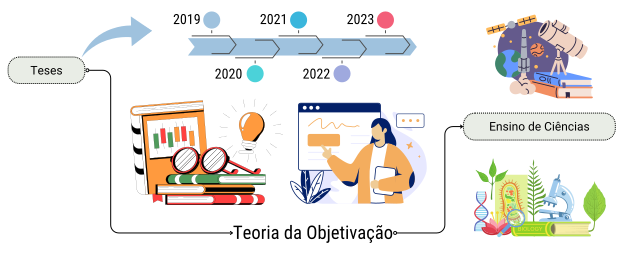
This study aims to map, through a systematic review, research conducted in Brazilian stricto sensu graduate programs (theses) on the Theory of Objectification (TO) in science teaching from 2019 to 2023. The review was carried out on the Brazilian Digital Library of Theses and Dissertations (BDTD) platform, initially resulting in 21 theses, of which only two addressed the relationship between TO and Science Teaching. Both studies employed action research, originated from federal universities in the central-western region of Brazil, and focused on teacher training. The research highlighted that this teaching method positively impacts teachers' critical attitudes toward their pedagogical practice and the education system, while also fostering changes in planning and conducting science lessons through collaborative efforts with students. This approach was identified as a unique and motivating experience in science teaching. However, there is a significant gap in studies on the application of the Theory of Objectification in science teaching. Future research could explore this approach in different regions, educational levels, and with varied methodologies, expanding the understanding of its impact on teacher education and practice in science.
- References
-
Camargo, F. & Daros, T. (2018). A sala de aula inovadora: estratégias pedagógicas para fomentar o aprendizado ativo. Porto Alegre: Penso. 144 p.
Camilotti, D. C., & Gobara, S. T. (2021). Formação continuada e permanente de professores: emancipação coletiva das práticas pedagógicas alienantes. REMATEC, 16(39), 01–18. https://doi.org/10.37084/REMATEC.1980-3141.2021.n39.p01-18.id493 DOI: https://doi.org/10.37084/REMATEC.1980-3141.2021.n39.p01-18.id493
Chassot, A. I. (2017). Formação de professores no ensino de Ciências e Matemática. (2017). Eventos Pedagógicos, 8(1), 10-31. https://doi.org/10.30681/reps.v8i1.9887 DOI: https://doi.org/10.30681/reps.v8i1.9887
Freire, P. (2016). Pedagogia da solidariedade. São Paulo: Paz & Terra. 144 p. DOI: https://doi.org/10.4324/9781315422817
Gobara, S. T., & Santos, G. da R. (2024). O ensino de ciências à luz da Teoria da Objetivação: a ética comunitária como alternativa para a sala de aula. PARADIGMA, 45(2), e2024005. https://doi.org/10.37618/paradigma.1011-2251.2024.e2024005.id1578 DOI: https://doi.org/10.37618/PARADIGMA.1011-2251.2024.e2024005.id1578
Gobara, S. T. & Radford, L. (2020). Teoria da objetivação: fundamentos e aplicações para o ensino e aprendizagem de Ciências e matemática. São Paulo: Editora Livraria da Física. 293 p.
Gobara, S. T.; Silva, R. C. da, & Vargas Plaça, J. S. (2019). A Teoria da Objetivação: novas perspectivas para o ensino e aprendizagem de física. Revista EDUCAmazônia -Educação Sociedade e Meio Ambiente, 23(22), 47-69.
Hegel, G. W. F. (1977). Hegel's phenomenology of spirit. Oxford: Oxford University Press. 640 p.
Kitchenham, B. (2004). Procedures for performing systematic reviews. Keele, UK, Keele University, 33(2004), 1-26.
Moda, S. C. (2017). O ensino da ciência e experiência visual do surdo: o uso da linguagem imagética no processo de aprendizagem de conceitos científicos. Dissertação de Mestrado em Educação em Ciências na Amazônia. Universidade do Estado do Amazonas, Manaus. 146 p. Disponível em: http://repositorioinstitucional.uea.edu.br/handle/riuea/2477.
Morey, B. B., & Nascimento, V. L. do. (2020). Historia de las matemáticas en la educación matemática. PARADIGMA, 180–196. https://doi.org/10.37618/PARADIGMA.1011-2251.2020.p180-196.id837 DOI: https://doi.org/10.37618/PARADIGMA.1011-2251.2020.p180-196.id837
Pedroso, A. P. (2021). Experiência docente e a teoria da objetivação: Reflexões para a formação de professores que ensinam matemática. Revista de Educação da Universidade Federal do Vale do São Francisco, 11(24), 467-490.
Radford, L. (2017). A Teoria da Objetivação e seu lugar na pesquisa sociocultural em educação matemática. In: Moretti, V. D; Cedro, W. L. (Org.). Educação matemática e a teoria histórico-cultural: um olhar sobre as pesquisas. Campinas: Mercado das Letras. p. 229-261.
Radford, L. (2020). ¿Cómo sería una actividad de enseñanza-aprendizaje que busca ser emancipadora? La labor conjunta en la teoría de la objetivación. Revista Colombiana de Matemática Educativa (RECME), 5(2), 15-31. DOI: https://doi.org/10.37084/REMATEC.1980-3141.2020.n16.p27-42.id306
Radford, L. (2021). The theory of objectification: A Vygotskian perspective on knowing and becoming in mathematics teaching and learning. Brill/Sense: Leiden, The Netherlands. https://doi.org/10.1163/9789004459663 DOI: https://doi.org/10.1163/9789004459663
Santana, R. S.; Capecchi, M. C. V. de M. & Franzolin, F. (2018). O ensino de ciências por investigação nos anos iniciais: possibilidades na implementação de atividades investigativas. Revista Electrónica de Enseñanza de las Ciencias, 17(3), 686-710.
Santos, M. J. C. dos, & Almeida Neto, C. A. de. (2021). Teoria da Objetivação: reflexões sobre o engajamento nas aulas de matemática para uma aprendizagem colaborativa. REMATEC, 16(39), 101–118. https://doi.org/10.37084/REMATEC.1980-3141.2021.n39.p101-118.id490 DOI: https://doi.org/10.37084/REMATEC.1980-3141.2021.n39.p101-118.id490
Santos, W. L. P. dos. (2007). Educação científica na perspectiva de letramento como prática social: funções, princípios e desafios. Revista Brasileira de Educação, 12(36), 474–492. https://doi.org/10.1590/S1413-24782007000300007 DOI: https://doi.org/10.1590/S1413-24782007000300007
Sasseron, L. H., & de Carvalho, A. M. P. (2016). Alfabetização científica: uma revisão bibliográfica. Investigações em Ensino de Ciências, 16(1), 59–77.
Vargas Plaça, J. S., & Gobara, S. T. (2024). Práticas inclusivas na perspectiva da Teoria da Objetivação: Contribuições para a inclusão educacional. Revista Ensino em Debate, 2, e2024037. https://doi.org/10.21439/2965-6753.v2.e2024037 DOI: https://doi.org/10.21439/2965-6753.v2.e2024037
Vargas-Plaça, J. S., & Radford, L. (2023). Teoria da objetivação: um foco na produção de subjetividades. Revista Venezolana de Investigación en Educación Matemática, 3(3), 1–17. https://doi.org/10.54541/reviem.v3i3.71 DOI: https://doi.org/10.54541/reviem.v3i3.71
Viecheneski, J. P.; Lorenzetti, L. & Carletto, M. R. (2015). A alfabetização científica nos anos iniciais: uma análise dos trabalhos apresentados nos ENPECs. In: Anais do X Encontro Nacional de Pesquisa em Educação em Ciências – X ENPEC, Águas de Lindóia, 1-9.
Vygotski, L. S. (1929). II. The problem of the cultural development of the child. The Pedagogical Seminary and Journal of Genetic Psychology, 36(3), 415–434. https://doi.org/10.1080/08856559.1929.10532201 DOI: https://doi.org/10.1080/08856559.1929.10532201
- Cover Image
-
- Downloads
- Published
- 2024-11-23
- Issue
- Vol. 3 No. 1 (2024)
- Section
- Review Article
- License
-
Copyright (c) 2024 Patricia Campêlo do Amaral Façanha, Solonildo Almeida da Silva, Auzuir Ripardo de Alexandria

This work is licensed under a Creative Commons Attribution 4.0 International License.
This journal publishes its Open Access articles under a Creative Commons license (CC BY 4.0).
You are free to:
Share — copy and redistribute the material in any medium or format for any purpose, even commercially.
Adapt — remix, transform, and build upon the material for any purpose, even commercially.
The licensor cannot revoke these freedoms as long as you follow the license terms.Under the following terms:
Attribution — You must give appropriate credit, provide a link to the license, and indicate if changes were made. You may do so in any reasonable manner, but not in any way that suggests the licensor endorses you or your use.No additional restrictions — You may not apply legal terms or technological measures that legally restrict others from doing anything the license permits.
Notices:
You do not have to comply with the license for elements of the material in the public domain or where your use is permitted by an applicable exception or limitation.No warranties are given. The license may not give you all of the permissions necessary for your intended use. For example, other rights such as publicity, privacy, or moral rights may limit how you use the material.

How to Cite




Similar Articles
- Mariane Aparecida Cazarini, Suzete Souza Borelli, Curriculum and BNCC in initial pedagogy training at a private educational institution , Dataset Reports: Vol. 3 No. 1 (2024)
- Maria Fernanda de Oliveira Moraes, Rafael Carraro de Rezende, Caio Sachetto Toledo Bellini, Maria Inês Boechat Gomes, Surgical closure of the patent foramen ovale in the prevention of recurrent ischemic stroke in cases of cryptogenic ischemic stroke: a systematic review , Dataset Reports: Vol. 3 No. 1 (2024)
- Marcos Xavier Viana, Luiz Antônio Guimarães das Chagas, Rian Kayk de Souza Silva dos Santos, Patrícia dos Santos Trindade, The challenges of teaching in the interior of Amazonas , Dataset Reports: Vol. 4 No. 1 (2025)
- Bernardo Toledo Linares, Camille Schmal dos Santos, Jenifer Cardoso Franco, Adriana Elisa Carcereri de Oliveira, Risk factors and suicide prevention among medical students: a literature review , Dataset Reports: Vol. 3 No. 1 (2024)
- Anderson Fuziel Machado, Patrícia dos Santos Trindade, The role of the supervising teacher in PIBID: reflections on teacher training and appreciation , Dataset Reports: Vol. 3 No. 1 (2024)
- Ana Cristina da Silva Marcolino, Claudia Dayse Gomes de Paiva, Fabrícia Raquel de Oliveira Araújo, Mama Panya's pancakes: interdisciplinarity in geography teaching , Dataset Reports: Vol. 3 No. 1 (2024)
- Infeliz Carvalho Coxe, Acácio da Conceição de Jesus Domingos, Dynamic model inspired by artificial intelligence for engineering education and complex systems design: a nonlinear differential systems approach , Dataset Reports: Vol. 5 No. 1 (2026)
- Maria Julia Santana Santos Cotta, Thays Caroline Adriano do Nascimento Murad, Daniel Freitas Cotta, Sensitization with immunotherapy in patients with food allergy: an integrative literature review , Dataset Reports: Vol. 3 No. 1 (2024)
- Márcia de Souza Damasceno, Digital reading of literary works in comics format during the COVID-19 pandemic , Dataset Reports: Vol. 2 No. 1 (2023)
- Micael Sampaio da Silva, The role of phytotherapics for oral health promotion in primary care dentistry: a mini-review , Dataset Reports: Vol. 2 No. 1 (2023)
You may also start an advanced similarity search for this article.