
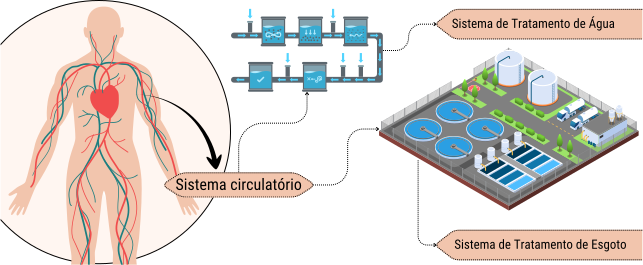
How the human circulatory system can be compared to a city's water and sewage treatment system
- Authors
-
-
Fabio José Buchedid Vazquez
Universidade Anhembi-Morumbi
-
- Keywords:
- Human circulatory system, Water treatment system, Hydraulic processes, Filtration processes
- Abstract
-
This article explores the similarities between the human circulatory system and the water and sewage treatment system used in cities. Through an analogical analysis, hydraulic and filtration processes are highlighted as common elements in both systems. In the human body, the heart, arteries, veins, lungs, and kidneys perform vital functions for blood transport and purification, while in urban systems, pipes, pumps, and treatment plants ensure the supply of clean water and safe waste disposal. Although they share fundamental principles such as fluid dynamics and efficient transport, biological systems exhibit greater complexity and adaptability. This study emphasizes the importance of biological inspirations for the advancement of human technologies, highlighting the efficiency and resilience of the human body.
- References
-
Águas de Corupá. (sd). Processo de Tratamento de Água. Acesso em: 3 de dezembro 2024. Disponível em: <https://aguasdecorupa.com.br/institucional/processo-de-tratamento-de-agua>.
Araújo, K. S. D., Antonelli, R., Gaydeczka, B., Granato, A. C., & Malpass, G. R. P. (2016). Processos oxidativos avançados: uma revisão de fundamentos e aplicações no tratamento de águas residuais urbanas e efluentes industriais. Revista Ambiente & Água, 11, 387-401. https://doi.org/10.4136/ambi-agua.1862 DOI: https://doi.org/10.4136/ambi-agua.1862
Associação Brasileira de Normas Técnicas – ABNT. (1997). NBR 8160: Sistemas prediais de esgoto sanitário - Projeto e execução. ABNT: Rio de Janeiro.
Çengel, Y.; Cimbala, J. M. (2007). Mecânica dos fluidos: Fundamentos e Aplicações. São Paulo: Mc Graw Hill Editora.
Cornelli, R., Amaral, F. G., Danilevicz, Â. D. M. F., & de Macedo Guimarães, L. B. (2014). Métodos de tratamento de esgotos domésticos: uma revisão sistemática. Revista de Estudos Ambientais, 16(2), 20-36. https://doi.org/10.7867/1983-1501.2014v16n2p20-36
López-Manjón, A., & Angón, Y. P. (2009). Representations of the human circulatory system. Journal of Biological Education, 43(4), 159-163. https://doi.org/10.1080/00219266.2009.9656176 DOI: https://doi.org/10.1080/00219266.2009.9656176
Mahmoud, A., Alsalemi, A., Bensaali, F., Hssain, A. A., & Hassan, I. (2021). A review of human circulatory system simulation: Bridging the gap between engineering and medicine. Membranes, 11(10), 744. https://doi.org/10.3390/membranes11100744 DOI: https://doi.org/10.3390/membranes11100744
Portal São Francisco. (2016). Éfeso. Acesso em: 3 dez. 2024. Disponível em: <https://www.portalsaofrancisco.com.br/turismo/efeso>.
Rodrigues, A. D., & Ribeiro, L. R. (2021). Sistemas sanguíneos, incompatibilidade e procedimentos alternativos à transfusão. Brazilian Journal of Development, 7(2), 13007-13027. https://doi.org/10.34117/bjdv7n2-085 DOI: https://doi.org/10.34117/bjdv7n2-085
Silva Júnior, A. G. da. (2016). Equação de Bernoulli. Slides de aula. Curso: Técnico em Mecânica. Disciplina: Mecânica dos Fluidos. Instituto Federal do Rio Grande do Norte. Disponível em: <https://docente.ifrn.edu.br/andouglassilva/disciplinas/mecanica-dos-fluidos/aula-5-equacao-de-bernoulli>.
ScienceDaily. (2013). Blood is thicker than water – and blood plasma is, too. ScienceDaily Acesso em: 3 de dezembro 2024. Disponível em: <https://www.sciencedaily.com/releases/2013/02/130218092505.htm>. DOI: https://doi.org/10.1063/pt.5.010217
Souza, J. L. D. de, Kadosaki, D. J., da Luz, P. N. V., Costa, B. N., da Silva, I. C. S., & Gonçalves, C. K. (2020). Internações e procedimentos cirúrgicos de urgência de doenças do sistema circulatório no Brasil. Brazilian Journal of Health Review, 3(5), 11691-11700. https://doi.org/10.34119/bjhrv3n5-027 DOI: https://doi.org/10.34119/bjhrv3n5-027
Wikimedia Commons. (2020). File:Human circulatory system.svg -. Acesso em: 3 de dezembro de 2024. Disponível em: <https://commons.wikimedia.org/wiki/File:Human_circulatory_system.svg>.
- Cover Image
-
- Downloads
- Published
- 2024-12-04
- Issue
- Vol. 3 No. 1 (2024)
- Section
- Review Article
- License
-
Copyright (c) 2024 Fabio José Buchedid Vazquez

This work is licensed under a Creative Commons Attribution 4.0 International License.
This journal publishes its Open Access articles under a Creative Commons license (CC BY 4.0).
You are free to:
Share — copy and redistribute the material in any medium or format for any purpose, even commercially.
Adapt — remix, transform, and build upon the material for any purpose, even commercially.
The licensor cannot revoke these freedoms as long as you follow the license terms.Under the following terms:
Attribution — You must give appropriate credit, provide a link to the license, and indicate if changes were made. You may do so in any reasonable manner, but not in any way that suggests the licensor endorses you or your use.No additional restrictions — You may not apply legal terms or technological measures that legally restrict others from doing anything the license permits.
Notices:
You do not have to comply with the license for elements of the material in the public domain or where your use is permitted by an applicable exception or limitation.No warranties are given. The license may not give you all of the permissions necessary for your intended use. For example, other rights such as publicity, privacy, or moral rights may limit how you use the material.


How to Cite




Similar Articles
- Fabio José Buchedid Vazquez, José Lopes Vazquez, Knowledge management applied to e-banking processes , Dataset Reports: Vol. 3 No. 1 (2024)
- Alexandro Luiz Guiguel, Fernanda Ayumi Yamada, Vivian Cristina Ito, Dietary profile and symptoms of people living with HIV/AIDS residing in the city of Ponta Grossa/PR , Dataset Reports: Vol. 3 No. 1 (2024)
- Milena de Almeida Campista Sousa, Bernardo Toledo Linares, Camila Soranço Castilho, Maria Clara Salomão, Maria do Carmo Mattos, Impacts of semaglutide treatment on the progression of chronic kidney disease in diabetic patients , Dataset Reports: Vol. 3 No. 1 (2024)
- Infeliz Carvalho Coxe, Acácio da Conceição de Jesus Domingos, Dynamic model inspired by artificial intelligence for engineering education and complex systems design: a nonlinear differential systems approach , Dataset Reports: Vol. 5 No. 1 (2026)
- Jamille Mariosa Ferreira, Maria Eduarda Rezende Costa, Ingryd Oliveira Almeida, Bronchiolitis treatment management: strategies for relieving respiratory symptoms , Dataset Reports: Vol. 3 No. 1 (2024)
- Eduarda Medran Rangel, Adrize Medran Rangel, Fernando Machado Machado, Use of organic waste for the production of adsorbents , Dataset Reports: Vol. 2 No. 1 (2023)
- Willyana Vitória Pitangui de Souza, Letícia Ornélas de Lima, Suzane Monteiro Oliveira, Lorena Carvalho Alves, Neurological complications in pediatric patients due to SARS-CoV-2 infection , Dataset Reports: Vol. 3 No. 1 (2024)
- Maria Vitória Gilvan da Silva, Gabriel Silva Pereira, Pedro Lucas Figueiredo Nunes, Guilherme Henrique de Oliveira Domingos, Eliezer Lucas Pires Ramos, João Paulo Martins do Carmo, Vinícius José de Oliveira, Epidemiologic profile of scorpion sting accidents in the duodecennial between 2011 and 2022 in the southeastern region of Brazil , Dataset Reports: Vol. 2 No. 1 (2023)
- Maria Ederlane de Jesus Santos, Ananda Almeida Santana Ribeiro, Ana Karoliny Silva de Lima, Rita de Cácia Rodrigues dos Santos, Mayara Pereira Santos Souza, Exploring physiotherapeutic interventions for female sexual dysfunctions and empowering women’s health and autonomy. An integrative review , Dataset Reports: Vol. 2 No. 1 (2023)
- José de Carlos Batista, Urban mobility in small cities – transportation and road infrastructure challenges: how these issues impact the daily lives of residents in Forquilha, CE , Dataset Reports: Vol. 3 No. 1 (2024)
You may also start an advanced similarity search for this article.
Most read articles by the same author(s)
- Fabio José Buchedid Vazquez, Artificial intelligence applied to health: Quality in the search for diagnosis , Dataset Reports: Vol. 3 No. 1 (2024)
- Fabio José Buchedid Vazquez, Hugo Henrique da Silva, Vander da Silva e Sousa, Industry 4.0 in Logistics 4.0 , Dataset Reports: Vol. 3 No. 1 (2024)
- Fabio José Buchedid Vazquez, Julio Cesar Pavanelli Jacinto, Cavitation issues and prevention strategies , Dataset Reports: Vol. 3 No. 1 (2024)
- Fabio José Buchedid Vazquez, Cyber incident response policy and strategies for compliance with Brazilian regulation , Dataset Reports: Vol. 3 No. 1 (2024)
- Fabio José Buchedid Vazquez, Best practices in telecommunications management and data privacy: network and information systems management , Dataset Reports: Vol. 3 No. 1 (2024)
- Fabio José Buchedid Vazquez, Eduardo Andrade Junqueira, Design Thinking, the new management of creativity , Dataset Reports: Vol. 3 No. 1 (2024)
- Fabio José Buchedid Vazquez, Organizational management, the new innovation-driven leadership , Dataset Reports: Vol. 3 No. 1 (2024)
- Fabio José Buchedid Vazquez, José Lopes Vazquez, Knowledge management applied to e-banking processes , Dataset Reports: Vol. 3 No. 1 (2024)